Why Grip Strength Gives Out Before the Muscles It's Supposed to Support
Quick Answer: Your grip gives out first because forearm muscles are small, sustained gripping restricts their own blood flow, and grip strength adapts more slowly than general strength. That’s a bottleneck, not a weakness. Fix it with dedicated grip work, straps on sets where the back is the real target, and actual progressive overload on grip itself.
The bar starts slipping out of your fingers at rep six. Your back feels like it had three more in it.
That’s not a willpower failure. Your hands and your back are running on genuinely different clocks.

Why Does Grip Fail Before the Bigger Muscles?
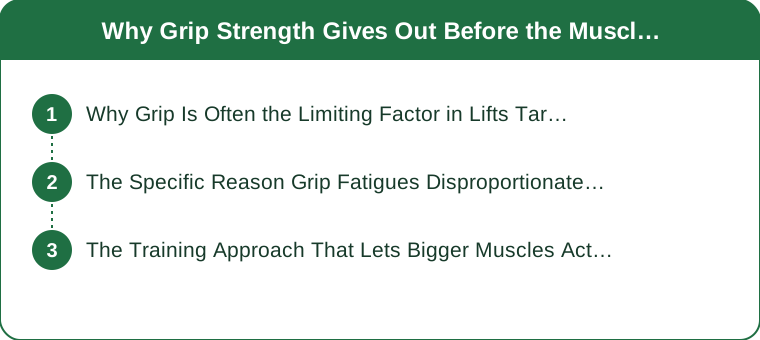
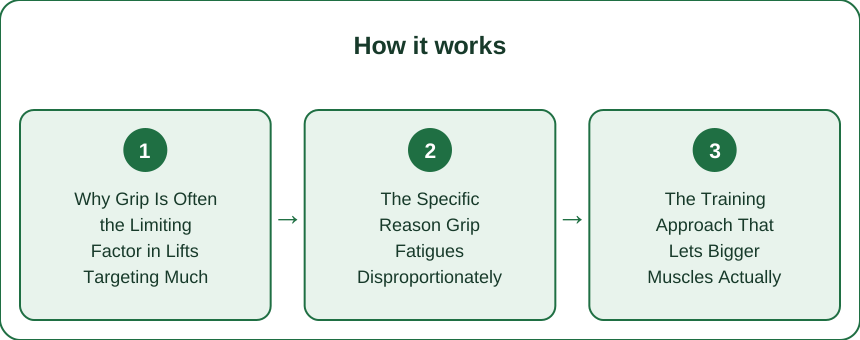
Three reasons stack, and each one is enough to matter on its own.
Small muscles, big job. Forearm and hand muscles have far less cross-sectional area than the muscles a deadlift is actually training. You’re asking a small motor to gate the output of a much larger one. It gates.
Sustained grip restricts its own blood flow. Holding a bar is a continuous isometric contraction, and sustained isometric tension partially occludes blood flow within the working muscle. That’s mechanistically different from what your back is doing — dynamic contractions with brief relaxation phases that let blood move. Your forearms are working under a self-imposed blood flow restriction for the entire set. Your lats aren’t.
Grip adapts slowly. Grip-specific strength develops on a slower timeline than general strength gains. So as your pulling numbers climb over months, grip capacity lags behind unless something is training it directly — and the gap widens rather than closing.
Put those together and grip failing first isn’t a surprise. It’s the expected outcome of an untrained bottleneck.
Why Does Grip Fatigue Feel So Sudden?
Because occlusion-driven fatigue has a different curve than dynamic fatigue.
Your back gives you warning. Reps get slower, form degrades gradually, you can feel the set ending. Grip doesn’t do that. It holds, holds, holds — and then the bar is genuinely moving in your hand and there’s nothing available to stop it.
That cliff is why people misread it as a mental failure. It arrives without the gradual decline that normally precedes failure elsewhere, so it feels like you decided to let go.
You didn’t. The muscle ran out, and it ran out on a curve you’re not used to reading.

5 Mistakes Everyone Makes With Grip
- Assuming grip trains itself. Incidental grip demand from your regular lifts maintains grip. It doesn’t progressively overload it, which is why it plateaus.
- Refusing straps on principle. If the goal of a set is back hypertrophy and grip cuts it three reps short, you’re not training your back — you’re training your forearms badly.
- Using straps for everything. The opposite error. Now grip never gets trained at all and the bottleneck permanently narrows.
- Only training crush grip. Grippers are one type. Carries, dead hangs, and pinch work train capacities that grippers don’t.
- Doing grip work first. The third mistake surprises people, but this is the one that quietly wrecks sessions: fatiguing your grip before deadlifts guarantees the bottleneck shows up early.
How Do You Train Grip So It Stops Limiting You?
Add dedicated grip training, separate from your compound lifts. Three formats cover most of it:
- Loaded carries. Farmer’s walks are the highest-value option here — sustained heavy holding under movement. Two or three sets of 30–40 metres with the heaviest dumbbells you can hold cleanly.
- Dead hangs. Simple, free, effective. Three sets to near-failure, a few times a week. Track the seconds; that’s your progression metric.
- Grip tools — grippers, pinch plates, thick-bar work — if you want to target specific grip types.
Put all of this at the end of a session, never before pulling work.
Use straps strategically, not ideologically. On heavy back sets where the lat or the posterior chain is clearly the target and grip is an artificial limiter, strap up and train the muscle you came for. On your working sets where building grip is part of the point, go without. Both are correct in their place.
Apply real progressive overload to grip. This is the piece almost everyone skips. Track your hang time, your carry weight, your carry distance — and increase them deliberately over weeks, the way you would a squat. Grip doesn’t improve automatically as a side effect of anything. Train it like a lift and it behaves like one.
Realistic timeline: noticeable change in 6–8 weeks of consistent dedicated work. It’s slower than most adaptations, which is exactly why it fell behind in the first place.
Practical note: heavy carries and hangs mean sweat, chalk, and repeated contact with your legs and sides. Fitted training gear that stays put — squat-proof high waist leggings rather than anything loose enough to catch a dumbbell — makes carries considerably less annoying.
When to see a professional: persistent forearm pain, elbow pain, or numbness and tingling in the fingers isn’t grip fatigue and shouldn’t be trained through. This is general information, not medical advice.
FAQ
Are lifting straps cheating?
Only if the goal was grip. On a set where the back is the target and grip is the bottleneck, straps let you actually train the intended muscle. Just don’t use them on every set forever.
How often should I train grip directly?
Two to three short sessions a week, at the end of workouts, is plenty. Grip work is easy to overdo, and forearms are already getting incidental work from everything else you pull.
Will a stronger grip improve my deadlift?
It removes a limiter, which often shows up as more usable reps at a given weight. It won’t add strength to your posterior chain — it just stops the hands from ending the set early.
TL;DR
- Grip fails first because forearm muscles are small, sustained gripping restricts their own blood flow, and grip adapts slowly.
- The failure feels sudden because occlusion fatigue has a sharper curve than dynamic fatigue.
- Train it directly: carries, dead hangs, grip tools — at the end of sessions, never before pulling.
- Use straps selectively when the larger muscle is the real target.
- Progressively overload grip like any other lift; expect 6–8 weeks for noticeable change.
Keep Reading
This article is for general informational purposes only and is not medical advice. Always consult a qualified health professional for guidance specific to you.