5 Grip Positions That Expose a Weakness a Dynamometer Misses
Quick Answer: A hand dynamometer only measures crush grip in one fixed position, and grip has at least three fairly independent qualities — crush, pinch and support. You can post a respectable squeeze number and still fail on a 30-second hang, a wide pinch, or anything held at arm’s length. Test all five positions below and the weak link usually announces itself in the first session.
Your dynamometer says 32 kilos. Solid, above average, nothing to worry about.
Then a farmer’s carry falls out of your hands at 40 metres and a plate pinch lasts four seconds.
Both of those are grip. The squeeze test just did not ask about them.

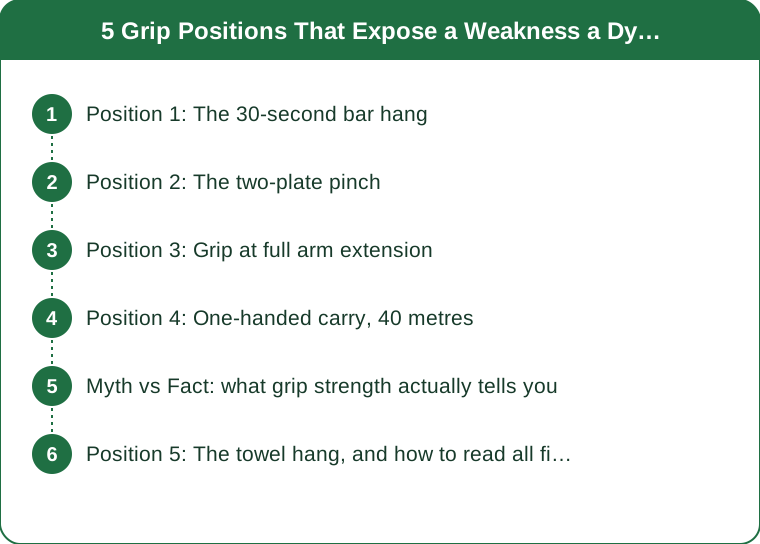
Position 1: The 30-second bar hang
Hang from a straight pull-up bar, thumb wrapped, feet off the floor, and count.
This tests support grip — the ability to hold a closed hand shut under load over time, which is what almost every real task actually asks of you. Carrying shopping, holding a deadlift, hanging off a rock hold, keeping a suitcase off the floor at the airport.
A reasonable target for most trained women is 30 seconds unbroken, with 60 seconds marking genuinely strong support grip. If you can squeeze 30-plus kilos on a dynamometer but you drop off the bar at 15 seconds, your problem is not strength — it is endurance under sustained closure, and it responds fast to being trained directly.
Two or three hangs to near-failure, twice a week, will usually move a 15-second hang to 35 or 40 within a month. It is one of the fastest-responding qualities in the whole body.
The tell that it is a support-grip issue and not a shoulder issue: your fingers slowly open while your arms feel fine.
Position 2: The two-plate pinch
Stack two smooth 5-kilo plates flat side out, and pick the pair up by pinching the outer faces between thumb and fingertips.
This is pinch grip, and it is the quality most people have never trained at all. The thumb works against the fingers rather than alongside them, and it uses the thumb adductors, which get almost no work from bars and handles.
Most people who can hang for a minute cannot hold a two-plate pinch for ten seconds. That gap is not a flaw — it just means your grip training has been entirely handle-shaped.
Why care? Pinch strength is the limiting factor in a surprising number of everyday tasks — lids, laptops carried one-handed, holding a phone while reaching for something, opening heavy fire doors. It also correlates well with thumb-side wrist and hand resilience.
Start with a single 5-kilo plate for 15 seconds per hand if the pair is impossible.
Position 3: Grip at full arm extension
Hold a dumbbell out in front of you at shoulder height, arm straight, and see how the hand behaves.
Grip is not independent of arm position. Your finger flexors cross the wrist and elbow, so where your arm sits changes how much force your hand can produce — a phenomenon straightforward enough that it shows up in any repeated dynamometer test done at different elbow angles.
Practically: a lot of women discover their grip is fine at the side and noticeably weaker overhead or at extension. That matters for overhead carries, kettlebell work, climbing moves above your head, and hanging from anything that is not directly overhead.
If position 3 is your weak link, the fix is not more forearm work. It is training holds in the position that fails — extended-arm holds, overhead carries, and slow lowers through that range.

Position 4: One-handed carry, 40 metres
Pick a load you can comfortably hold in one hand and walk 40 metres without swapping.
This adds two things the other tests do not: asymmetry and time under load with movement. Your torso has to resist being pulled sideways while your hand does its job, and the shaking of walking makes closure harder than a static hold.
Do both hands and note the difference. A 10 to 15 percent side-to-side gap is normal; over 20 percent is worth attention, especially if it is not your non-dominant hand that is weaker.
This is also the position that exposes thumb fatigue most clearly. Watch whether the load starts to rotate out of your hand rather than slipping down — rotation means the thumb is giving up first.
Myth vs Fact: what grip strength actually tells you
Myth: grip strength is a forearm-size thing. Fact: forearm circumference and grip strength correlate weakly. Tendon stiffness, neural drive and hand structure matter more, which is why some very slim hands squeeze remarkably hard.
Myth: if your grip is weak, train it every day. Fact: finger flexors recover like any other muscle. Daily maximal grip work is one of the more reliable routes to a cranky wrist or a sore thumb base. Two to three focused sessions a week is plenty.
Myth: straps make your grip weaker. Fact: straps let you load your back harder than your hands allow, and they do not shrink your grip if you train grip separately. Using straps for heavy pulls and then doing dedicated hangs is a better plan than refusing straps and undertraining your back.
Myth: one number tells you where you stand. Fact: this whole article is that argument. Crush, pinch and support are only loosely related — strong in one says little about the others.
Myth: grip work is only for lifters. Fact: grip strength is one of the better-studied simple markers of general physical capacity across adult populations, and it is also the thing that decides whether you can carry everything in from the car in one trip.
Position 5: The towel hang, and how to read all five together
Throw a towel over the bar and hang from the two ends.
The towel removes the fixed diameter that a bar gives you, so your fingers have to close further and hold a shape rather than wrap a cylinder. It is brutal, and it is the closest thing on this list to a worst-case grip demand.
Nobody should expect a towel hang to match a bar hang. Half the time is respectable.
Now put the five together. The pattern tells you what to train:
- Bar hang short, everything else fine → support endurance. Train hangs.
- Pinch far behind everything → thumb work. Plate pinches, and stop skipping them.
- Extended-arm weak only → position-specific. Train the failing angle.
- Big side-to-side gap on carries → unilateral carries, weaker hand first.
- Towel hang disproportionately bad → wide-open closure. Fat-bar and towel holds.
Test all five once, write the numbers down, retest in six weeks. Grip is unusually responsive, and it is one of the few qualities where a month of honest work produces a number you can actually feel in your hands.
TL;DR:
- A dynamometer measures crush grip in one position only — it says little about pinch or support.
- Test five positions: 30-second bar hang, two-plate pinch, extended-arm hold, 40-metre one-hand carry, towel hang.
- Pinch is the most commonly untrained quality, and the thumb usually fails before the fingers.
- A 10 to 15 percent side difference is normal on carries; over 20 percent is worth addressing.
- Grip responds quickly — two or three focused sessions a week moves the numbers within a month.
Run the five tests in one session, keep the numbers somewhere you will find them again, and pick the single worst result to train for the next six weeks. Chasing all five at once is how grip work turns into sore thumbs and nothing to show for it.
Keep Reading
This article is for general informational purposes only and is not medical advice. Always consult a qualified health professional for guidance specific to you.