Five Grip Strength Checkpoints You Can Test in Your Own Doorway
Quick Answer: Grip is not one capacity - it is at least four. Crush, support, pinch, and wrist stability all fail differently and train differently. These five checkpoints take about ten minutes total, need nothing but a doorway bar and a couple of household objects, and will tell you which one is actually limiting you.
Most people who say their grip is weak have never established which part is weak. That matters, because the training for a failing support grip looks nothing like the training for a failing pinch.

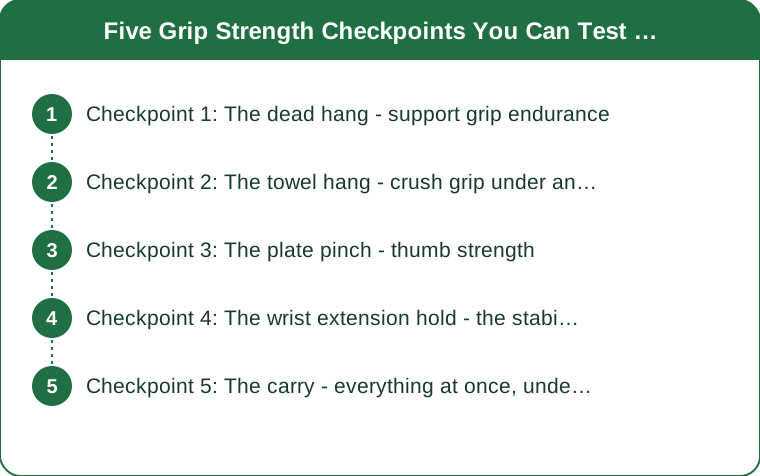
Checkpoint 1: The dead hang - support grip endurance
Hang from a bar with straight arms, hands shoulder width, and time it. This is the most informative single test in the whole list because support grip - the ability to hold onto something while loaded - is what limits most real activities, from carrying shopping to finishing a set of rows.
What the numbers mean. Under 15 seconds indicates support grip is your primary limiter and will be holding back most of your pulling work. 15 to 30 seconds is a common starting point for untrained adults. 30 to 60 seconds is solid general capability. Over 60 seconds means grip is unlikely to be what fails you in most training contexts.
Watch for the specific failure. If your fingers slowly open, that is support grip. If your shoulders shrug up to your ears and you feel it in your neck, that is scapular stability failing first and the grip result is not valid - retest after learning to hang with active shoulders.
Checkpoint 2: The towel hang - crush grip under an unstable load
Drape a towel over the bar and hang from the ends, one hand per end. The towel removes the fixed diameter of the bar and forces continuous crushing rather than passive hooking.
Expect roughly half your dead hang time. If you get 40 seconds on a bar and 20 on a towel, that ratio is normal. If you get 40 on a bar and 8 on a towel, your fingers have been relying on the bar’s shape rather than on actual crushing strength - common in people who train mostly on machines and standard bars.
This test predicts real-world carrying capacity better than the bar hang does, because almost nothing you carry in daily life has a convenient 1.25-inch diameter.

Checkpoint 3: The plate pinch - thumb strength
Pinch two smooth weight plates together, smooth sides out, and hold them at your side. No bar, no hook - just thumb against fingers. Household alternative: a stack of thick books held by the covers.
Pinch is the most commonly neglected grip capacity and the one that fails first with age. It is also the one least trained by conventional gym work, because almost every implement lets you wrap your fingers around it.
A reasonable benchmark is 20 seconds holding around 10 pounds per hand. More important than the absolute number is the left-right difference - a gap over about 20 percent is worth addressing directly, because it usually reflects an old injury or a strong-side habit that has quietly compounded.
Checkpoint 4: The wrist extension hold - the stabilizer everyone skips
Rest your forearm on a table, palm down, hand off the edge, holding a light weight. Lift the back of the hand up and hold. Thirty seconds with 3 to 5 pounds is a reasonable target.
This tests the extensors, which are the antagonists to everything else on this list and which almost nobody trains. Chronic imbalance between heavily trained flexors and untrained extensors is strongly associated with lateral elbow pain - the thing usually called tennis elbow, which is far more often caused by gripping than by tennis.
If this one is hard and the others were easy, you have found your answer. Adding two sets of banded finger extensions and wrist extensions twice a week is a small intervention that resolves a surprising amount of elbow and forearm discomfort.
Checkpoint 5: The carry - everything at once, under fatigue
Pick up the heaviest two objects you can safely hold and walk until your hands open. Bags of dog food, water containers, dumbbells - anything with a handle you can grip.
Aim for 30 to 60 seconds of continuous walking. The carry integrates every capacity above plus core and shoulder stability, which is why it is both the best single training exercise for grip and the best final test.
Note where it fails. Hands opening means grip. Torso collapsing sideways means core. Shoulders rounding forward means scapular endurance. The carry tells you which of the three is the actual constraint in a way that no isolated test can.
And retest all five in six weeks, not six days. Grip strength adapts on a similar timeline to any other strength quality - meaningful change takes six to eight weeks of consistent work. Write the five numbers down today so you have something honest to compare against.
TL;DR:
- Grip is four separate capacities - support, crush, pinch, and wrist stability - and they fail differently.
- Dead hang tests support grip; under 15 seconds means it is limiting your pulling work.
- Towel hang should be about half your bar hang; far less means you have been relying on bar shape.
- Pinch strength is the most neglected and the first to decline; check left-right symmetry.
- Wrist extension is the antagonist nobody trains and a common source of elbow pain.
- Loaded carries integrate everything and are the best single training exercise for all of it.
Keep Reading
This article is for general informational purposes only and is not medical advice. Always consult a qualified health professional for guidance specific to you.