Why Your Grip Gives Out Before Your Back or Legs Do During Heavy Lifts
Quick Answer: Your hands and forearms are tiny compared to your back and legs, they’re holding an isometric position while everything else works dynamically, and isometric holds fatigue faster. Add that grip strength progresses slower than compound strength unless you train it directly, and the gap widens every month. Fix it three ways: use straps on sets where back or legs are the target, train grip directly with carries and hangs, and switch to a mixed or hook grip on heavy pulls.
Set four of deadlifts. Your back feels great. Your legs feel great.
The bar is sliding out of your fingers at rep six like it’s been greased.
Your hands are not weak. They’re just very small and doing a completely different job.

Why Does Grip Fail First?
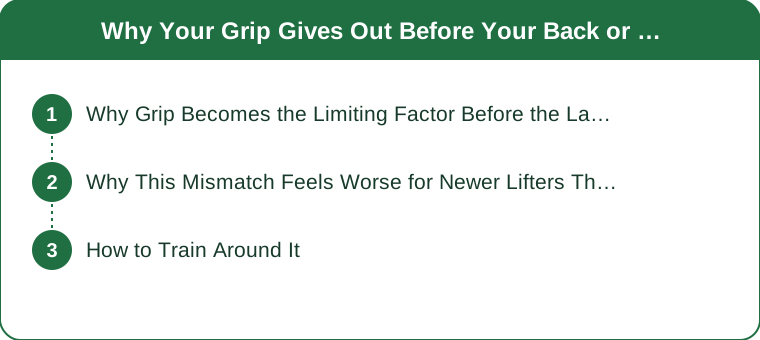
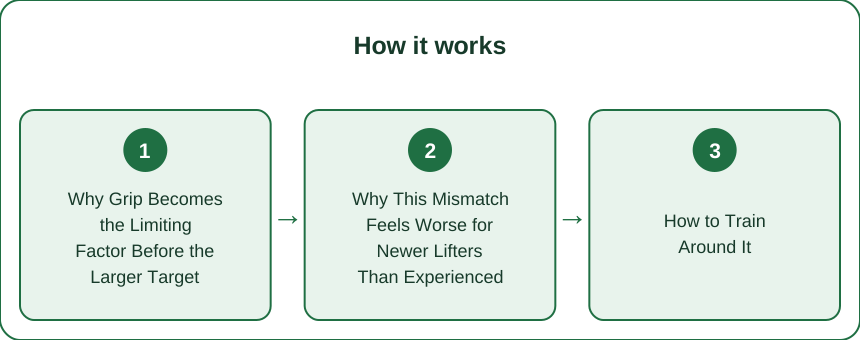
Size mismatch, first and foremost. The forearm and hand muscles responsible for grip have a fraction of the cross-sectional area of the back, glutes, and legs working in a deadlift. A much smaller muscle group is being asked to keep pace with much larger ones. It reaches its capacity limit first for entirely mechanical reasons.
Grip progresses slower unless you train it. Your deadlift might climb 100 lb over a year. Your grip, developing only incidentally as a byproduct of that lifting, doesn’t come close to matching that rate. So the gap doesn’t stay constant — it widens as you get stronger. The better your pull gets, the more likely grip becomes the thing that stops the set.
Isometric holds fatigue differently. Your back and legs are contracting and relaxing through a range of motion, which allows blood flow to cycle. Your grip is holding one sustained isometric contraction for the entire set, which restricts blood flow and fatigues faster for a given relative effort. Two different fatigue mechanisms running in the same rep.
Put together: a small muscle group, progressing slowly, doing the fatiguing kind of work. Grip failing first is exactly what you’d predict.

Why Does This Feel Worse When You’re Newer?
The gap is widest at the start. A newer lifter has done no dedicated grip work at all, so grip capacity sits at its untrained baseline while compound strength climbs quickly in the first year. That’s the maximum spread, and it’s why grip failure is such a common early frustration.
Experienced lifters accumulate incidental adaptation. Years of holding bars for thousands of reps produces real, if slow, grip development even without deliberate training. The gap narrows somewhat over time on its own.
So this does ease naturally — just slowly, and a lot faster if you help it along.
Myth vs Fact
Myth: Using straps is cheating and will make your grip weaker. Fact: Straps are a tool for making a set train what it’s supposed to train. If the point of a heavy rack pull is back development, letting grip cap the load means you undertrained your back to protect a variable that wasn’t the goal. The legitimate concern is using straps on everything, which does leave grip untrained — the fix for that is direct grip work, not strapless suffering.
Myth: Compound lifting alone builds all the grip you need. Fact: It builds some, slowly, and slower than the lifts themselves progress. That’s the whole mechanism behind the widening gap.
Myth: Grip failure means you should lower the weight. Fact: Only if grip is what you meant to train. Otherwise it means you should remove grip as the limiter and keep the load where your back and legs actually need it.
How Do I Train Around It?
Use straps strategically. On heavy back or leg sets where those muscles are the target, strap up. Reserve strapless work for your first working sets, or for sets you’re specifically using as grip training. Rough rule: strapless up to about 80% of your working weight, straps above that.
Train grip directly, as its own thing. This is what actually closes the gap, and it takes ten minutes twice a week:
- Farmer’s carries — 4 rounds of 40 yards, heaviest dumbbells you can hold.
- Dead hangs — 3 sets to near-failure from a pull-up bar, aiming to build toward 60 seconds.
- Timed static holds — hold a loaded barbell at lockout for 20–30 seconds, 3 sets.
Put these at the end of a session. Doing them first will sabotage your pulling work.
Use a better grip technique on heavy pulls. A mixed grip (one hand over, one under) or a hook grip (thumb under the fingers) both hold substantially more than a double overhand. Hook grip is genuinely unpleasant for the first few weeks and then stops being an issue. Mixed grip is easier immediately — just alternate which hand is which set to keep loading even, and be aware it introduces some asymmetry.
A safety note: sharp pain in the wrist, elbow, or the base of the thumb isn’t grip fatigue and shouldn’t be trained through. Persistent forearm pain, numbness, or tingling in the fingers is worth seeing a physical therapist about rather than adding more grip volume to.
Mini FAQ
How long until dedicated grip work makes a difference?
Most people notice a real change in 6–8 weeks of consistent twice-weekly work. Grip responds well; it just needs to actually be asked.
Should I use grip strengtheners?
The spring-handle kind trains crushing grip, which isn’t quite the same as the supporting grip a barbell needs. Carries and hangs transfer better to lifting. Strengtheners aren’t useless, just less specific.
Is chalk enough on its own?
Chalk helps a lot with the slipping part of the problem — it manages moisture and friction. It doesn’t help with the fatigue part. If your hands are opening rather than sliding, chalk won’t fix that.
TL;DR:
- Grip fails first because the muscles are much smaller, holding isometrically, and progressing slower.
- The gap widens as your compound lifts get stronger, unless you train grip directly.
- Straps on sets targeting back or legs; strapless below ~80% or when grip is the point.
- Direct work: farmer’s carries, dead hangs, timed holds — 10 minutes, twice a week, at session end.
- Mixed or hook grip holds far more on heavy pulls. See a PT for numbness, tingling, or sharp joint pain.
Keep Reading
This article is for general informational purposes only and is not medical advice. Always consult a qualified health professional for guidance specific to you.