Grip Training: 5 Signals Your Forearm Pump Won't Go Away On Its Own
Quick Answer: A forearm pump that fades within an hour or two is normal training fatigue; one that lingers into the next day, paired with weak grip or tingling, signals you’ve pushed volume past what your forearms can currently recover from.
Grip work looks deceptively simple — just squeeze things — which is exactly why it’s easy to overdo without realizing it until your forearms are still tight the next morning.

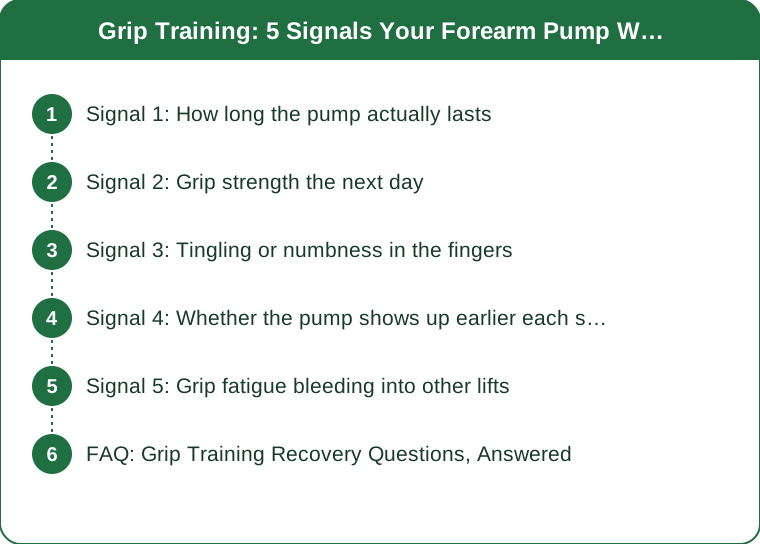
Signal 1: How long the pump actually lasts
A normal training pump — blood and fluid pooling in the worked muscle — typically fades within 30-90 minutes as circulation normalizes. If your forearms are still visibly swollen or tight more than a few hours later, that’s fluid retention from a workload your tissue isn’t yet adapted to, not just a good session.
Signal 2: Grip strength the next day
Testing your grip the morning after (a simple dead hang or hand-dynamometer check works) should show it’s roughly back to baseline. A noticeable drop — struggling to open a jar or feeling weak on your first sets — means recovery isn’t complete and adding more volume on top compounds fatigue instead of building strength.
Signal 3: Tingling or numbness in the fingers
Mild forearm tightness is expected, but tingling, numbness, or a pins-and-needles feeling in your fingers points toward nerve or tendon irritation, not just muscle fatigue. This is your body’s clearest stop signal — pushing through tingling risks tendon issues that take weeks, not days, to resolve.

Signal 4: Whether the pump shows up earlier each session
If you’re hitting the same pumped, fatigued feeling after fewer reps than last week, your forearms are accumulating fatigue faster than they’re recovering between sessions. This progressive-fatigue pattern is a clearer overtraining signal than any single day’s soreness.
Signal 5: Grip fatigue bleeding into other lifts
When your forearms are so cooked that deadlifts, pull-ups, or even carrying groceries feel harder than usual, grip training is eating into recovery capacity your whole training week depends on. Isolated grip fatigue is fine; grip fatigue that limits everything else means it’s time to back off frequency.
FAQ: Grip Training Recovery Questions, Answered
How many days between dedicated grip sessions is enough?
Most people recover forearm work in 48-72 hours, though heavier farmer’s carry or thick-bar sessions may need closer to 3-4 days, especially early in a new grip program.
Does stretching help clear the pump faster?
Gentle wrist and finger extensor stretches can support circulation and reduce tightness, but they won’t meaningfully speed true recovery if the underlying volume was simply too high for your current capacity.
Is it safe to keep training grip through mild soreness?
Mild, fading soreness with full strength restored is fine to train through; soreness paired with reduced strength or any tingling means skip or scale back that session.
TL;DR:
- Pump fading within a couple hours and full strength returning by next day is normal
- Lingering swelling, weak grip, or tingling the next day signals overreach
- Watch for the pump arriving earlier each session as an early warning sign
- Grip fatigue bleeding into unrelated lifts means it’s time to scale back
Forearms recover on their own timeline distinct from bigger muscle groups, so track these five signals rather than just pushing through by feel.
Keep Reading
This article is for general informational purposes only and is not medical advice. Always consult a qualified health professional for guidance specific to you.