5 Reasons Your Grip Strength Stalls Even Though You Train It Every Week
Quick Answer: Grip strength plateaus most often come from training the same grip type repeatedly (crush-only, ignoring pinch and support grip), inadequate recovery between forearm-heavy sessions, or simply not progressively loading — the fix is usually variety and tracked overload, not more frequent training.
Grip training gets treated as one skill, but it’s actually several distinct patterns, and stalling on one doesn’t mean your overall grip work isn’t paying off elsewhere.

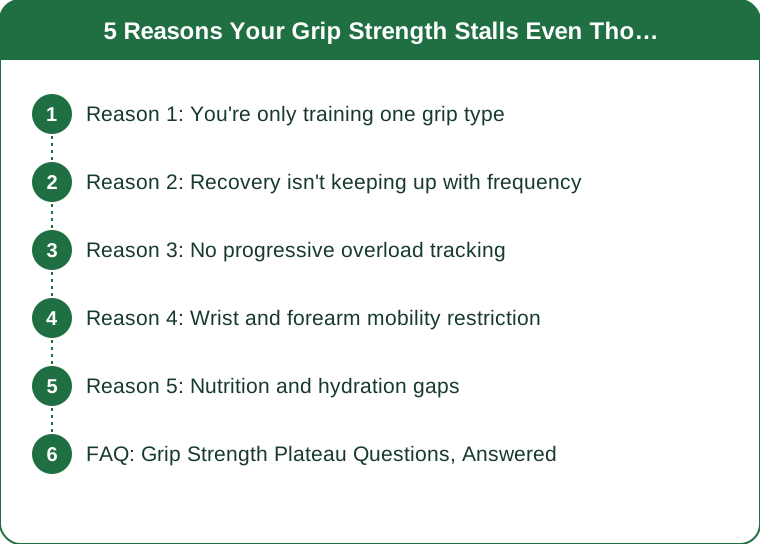
Reason 1: You’re only training one grip type
Grip strength splits into at least three distinct categories — crush grip (squeezing, like a hand gripper), pinch grip (thumb against fingers, like holding a plate), and support grip (holding a load for time, like a farmer’s carry or dead hang). Training only one type, most commonly crush grip with hand grippers, plateaus that specific pattern while leaving real strength on the table in the other two.
A farmer’s carry-heavy program that never includes pinch work will show excellent support grip progress alongside a genuine pinch grip weakness that shows up unexpectedly in daily tasks or other lifts.
Reason 2: Recovery isn’t keeping up with frequency
Forearm and hand muscles are small and recover differently than large muscle groups, but they’re not immune to overtraining. Training grip hard every single day without any lighter or rest days can lead to a stall that looks like a strength plateau but is actually accumulated fatigue preventing full effort on each session.
A noticeable sign: if your grip numbers are inconsistent session to session (strong one day, weak the next, no clear pattern), fatigue management is more likely the issue than a true strength ceiling.
Reason 3: No progressive overload tracking
Many grip routines default to the same exercises, same reps, same load indefinitely because grip training rarely gets the structured progression that a squat or bench program does. Without a written log of weights, hold times, or rep counts, it’s genuinely hard to tell if you’re progressing or just repeating the same stimulus — and repeating the same stimulus is exactly what causes a plateau.

Reason 4: Wrist and forearm mobility restriction
Limited wrist extension or forearm flexibility can cap how effectively you can generate crush or pinch force, independent of actual muscle strength. This is an underappreciated cause — someone can have strong forearm muscles that still test weak on a grip dynamometer because restricted wrist positioning prevents full force transfer.
A few minutes of wrist mobility work (extension and flexion stretches) before heavy grip work sometimes reveals immediate strength gains that had nothing to do with the muscle itself.
Reason 5: Nutrition and hydration gaps
Grip endurance specifically is sensitive to hydration status and electrolyte balance, since hand cramping under load is a common early fatigue signal. Chronic under-hydration or very low sodium intake, especially around training sessions, can make grip work feel harder than the actual strength level would predict, masking real progress underneath the fatigue.
FAQ: Grip Strength Plateau Questions, Answered
How do I know which grip type I’m neglecting?
Test all three periodically — a hand gripper for crush, holding a weight plate pinched between fingers and thumb for pinch, and a dead hang or farmer’s carry for support — and compare relative strength across the three rather than assuming they’re equal.
How often should grip-specific training happen for a natural lifter?
2-3 dedicated sessions per week with at least one lower-intensity day tends to balance progress against the recovery needs of smaller forearm musculature.
Is grip strength plateau ever a sign of a medical issue?
Persistent, unexplained grip weakness (especially one-sided or accompanied by numbness or tingling) is worth mentioning to a doctor rather than assuming it’s purely a training issue.
TL;DR:
- Crush, pinch, and support grip are separate skills — training only one plateaus that one while others may still be improving
- Untracked training with no progressive overload is a common, invisible cause of a stall
- Wrist mobility restriction and hydration status both affect grip performance independent of raw muscle strength
- Log your numbers across all three grip types to actually see where the plateau is and isn’t happening
Keep Reading
This article is for general informational purposes only and is not medical advice. Always consult a qualified health professional for guidance specific to you.