The Grip Lab: Strong Hands, Long Life
Quick Answer: Grip strength is one of the most consistent predictors of long-term health in large studies — but it predicts more than it causes. It works as a proxy for total-body muscle and neuromuscular health. Train it with dead hangs (60-90 seconds total, 3× weekly) and heavy carries, and you’ll improve the marker and the thing it’s measuring at the same time.
Someone shook your hand and you noticed. That’s basically the entire research finding, dressed up in a lab coat.
Grip strength became a longevity celebrity — the handshake that predicts lifespan, the dead hang as biological age test — and the headlines are surprisingly grounded in real research. What’s less well covered is what grip actually signals, and how little equipment it takes to train.

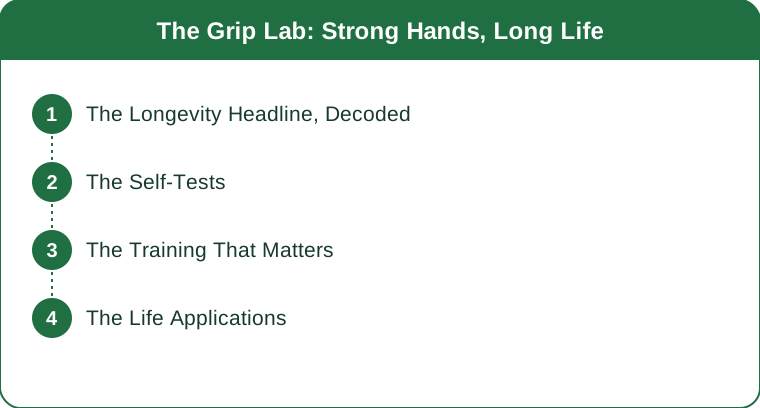
Does Grip Strength Really Predict How Long You’ll Live?
It predicts health outcomes with remarkable consistency. Large population studies have repeatedly found that dynamometer grip scores track with mortality, cardiovascular events and later-life disability — strongly enough that some researchers argue grip belongs alongside blood pressure as a routine vital sign.
But here’s the part the headlines skip: grip predicts more than it causes.
Grip is a proxy. Nobody has strong hands and an otherwise frail body — hand strength rides on total muscle mass, nervous system quality and overall physical activity. Squeeze a device harder and you’re revealing all of that at once. Which means training only your forearms won’t extend your life. Training your body, which strengthens your grip along the way, is the actual mechanism.
Grip is the thermometer. Strength is the health. Don’t spend a year on a gripper and think you’ve beaten the study.
How Do You Test Your Own Grip Strength at Home?
Three tests, no equipment required beyond a bar and something heavy:
1. The dead hang. Hang from a pull-up bar, both hands, feet off the floor. Time it.
- Under 15 seconds: this is your starting point, and it will move fast.
- 30+ seconds: a solid baseline for most women.
- 60+ seconds: genuinely strong.
2. The carry test. Pick up heavy dumbbells or two loaded grocery bags and walk. Measure the distance before your grip — not your legs — gives out. Repeat with the same weight monthly.
3. The daily-life audit. Jars, luggage, the car door in winter, holding a toddler on one hip. Unglamorous, but it’s the metric that actually matters.
Retest monthly. Grip responds fast and visibly, which makes it one of fitness’s most satisfying progress charts — and the third test is the one that surprises people, because it improves before the numbers do.

What Nobody Tells You About Training Grip
Your grip is probably capping lifts you don’t think of as grip exercises. Deadlifts, rows and pull-ups all end when your hands give out, often 2-3 reps before your back does. Fix the grip, unlock the lift.
Straps are not cheating — but they’re not step one either. Lifting straps let you load your back past what your hands can hold. Useful for heavy pulling once you’ve honestly trained bare-hand grip. Used from day one, they simply hide the weak link for years.
Grip has three separate flavors, and most people only train one. Crush (squeezing a gripper), support (hanging and carrying — the one that matters most for daily life), and pinch (holding a plate by its face). Support grip is where the health signal lives, and it’s the one hangs and carries build.
Forearms recover fast. Unlike your legs, grip work can go 3-4× weekly without much trouble. Small doses often beat one heroic session.
The gadgets are dessert, not the meal. Grippers, wrist rollers and grip balls are genuinely fun and mildly useful. They’re also the reason people spend $40 and skip the free thing that works better: hanging from a bar.
The Training That Actually Moves the Needle
You need a bar and something heavy. That’s the whole program.
Dead hangs — the all-star. Grip, shoulder health and spinal decompression in one exercise. Accumulate 60-90 seconds across 3-4 sets, 3× weekly. Can’t hang yet? Keep your toes on a box or chair to offload weight, and reduce the assistance over weeks.
Heavy carries — the farmer’s walk. Arguably the most functional strength exercise in existence. Two heavy dumbbells, kettlebells, suitcases or grocery bags. Walk 30-40 meters, set down, rest 60-90 seconds, repeat 3-4 times. Go heavy enough that the last few steps are a genuine negotiation.
Rows and pulls — the free dividend. Every pulling exercise trains grip at no extra cost. The pull-up project and the grip project are the same project. Do them without straps until the weight genuinely demands otherwise.
Progression is simple: add 5 seconds to your hang or 5 lb to your carry every week or two. Grip strength climbs quickly for the first 8-12 weeks, then slows to a normal strength curve like everything else.
A note on balance and when to see a professional: grip work is generally safe, but persistent elbow pain (golfer’s or tennis elbow), numbness or tingling in the fingers, or wrist pain that lingers past a couple of days are worth a physical therapist’s opinion rather than more volume. If you have arthritis, carpal tunnel or a history of shoulder injury, get your hang and carry plan cleared first — hanging loads the shoulder as much as the hand.
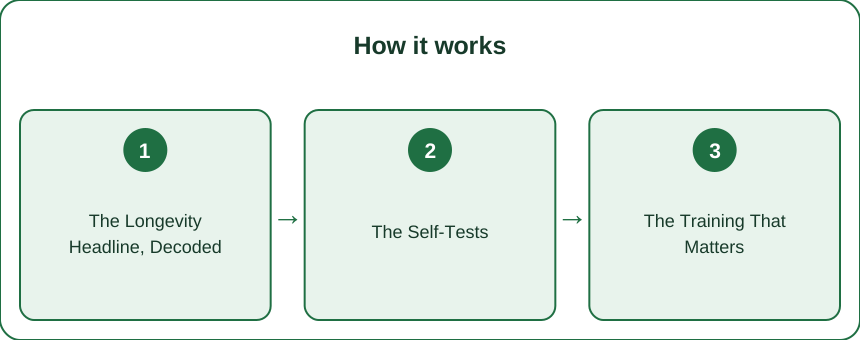
Where Strong Hands Actually Pay Off
The jar economy, obviously. But the real dividends are bigger:
- Carry-everything capability — groceries, luggage, children. The practical strength people use daily and never train deliberately.
- Sport unlocks — climbing, bouldering, tennis, pickleball and every racket sport run on grip. So does anything involving a rope, an oar or a barbell.
- Aging-proofing — grip is what keeps handrails, lids and independence workable for decades. This is the longevity connection made concrete, and it’s the one worth taking seriously in your 40s rather than your 70s.
- Training carryover — your deadlift and row numbers stop being limited by your hands.
Kit note: chalk helps more than any gadget, and dry hands matter. For carries and hangs, wear something you can move in that isn’t going to shift on you mid-set — a pair of high waist yoga pants with a waistband that stays put beats loose shorts that need adjusting every time you set the weight down.
FAQ
How long does it take to improve grip strength?
Most people add meaningful hang time within 3-4 weeks of consistent work, and see clear carry-distance gains by week 8. Grip responds faster than most muscle groups because it’s usually undertrained rather than genuinely maxed out.
Should I buy a hand gripper?
Only if you enjoy them. Grippers train crush strength, which is the flavor least connected to the health markers and daily tasks that matter. A pull-up bar and two heavy objects beat a gripper for almost every goal, at a fraction of the cost.
Can I train grip every day?
Most people can handle grip work 3-4 times a week without issue since forearms recover quickly. Daily heavy hanging is more than most shoulders want, though. If your hands feel achy or your elbows start talking to you, take 48 hours off — that’s the signal, not a suggestion.
TL;DR
- Grip predicts health outcomes strongly — but as a proxy for whole-body strength, not as a direct cause.
- Test yourself: dead hang time, loaded carry distance, and the honest daily-life audit. Retest monthly.
- Train it with hangs (60-90 seconds total, 3× weekly) and heavy carries (3-4 walks of 30-40m).
- Skip straps until bare-hand grip has been trained honestly; skip gadgets entirely unless you like them.
- Support grip — hanging and carrying — is the flavor that matters most, and the one most people never train.
- Persistent elbow, wrist or finger symptoms mean see a professional, not add volume.
Keep Reading
This article is for general informational purposes only and is not medical advice. Always consult a qualified health professional for guidance specific to you.