5 Grip Positions That Tell You Exactly Where Your Weakness Is
Quick Answer: Grip breaks down into crush, support, pinch and extension, plus wrist stability underneath all of them. Most people train only crush and wonder why heavy holds still fail. Test all five positions, find the one that gives out first, and train that specifically — the carryover to everything else is much faster than adding general forearm volume.
You can hang for a minute and still lose a deadlift to your hands. You can crush a gripper and still fail a farmer’s carry at forty metres.
That is because grip is at least four separate capacities sharing a forearm, and the one that limits you is probably not the one you have been training.
Position 1: The dead hang — support grip
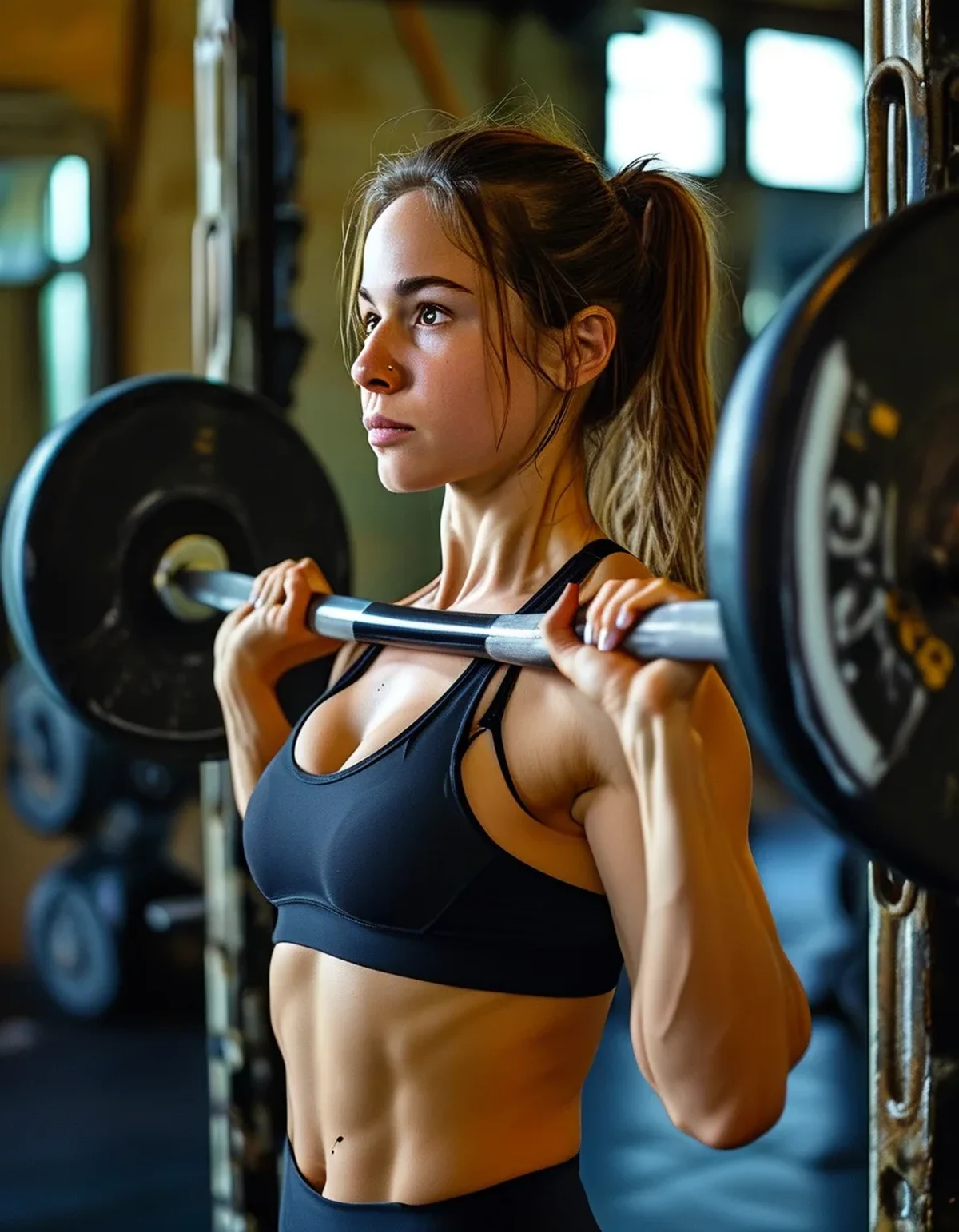
What it tests: support grip, which is the ability to hold a static closed position under load for time. This is the grip that fails on deadlifts, rows, pull-ups and carries, and it is the single most relevant one for most training.
How to test it: hang from a pull-up bar, feet off the ground, hands shoulder width, no straps and no hook grip. Time it. Under 30 seconds is a genuine limiter, 30–60 seconds is average, and over 60 seconds means support grip is not what is holding you back.
What it actually involves: an isometric hold by the finger flexors, with the load concentrated at the first joint of the fingers. It is largely an endurance quality rather than a maximal strength one, and it responds very quickly to being trained — often noticeably within two weeks.
How to train it: the test is the exercise. Three to four hangs of 20–40 seconds at the end of a session, two or three times a week. Progress by adding time first, then load with a belt. Bar thickness is the variable that changes it most — a slightly thicker bar or a towel over the bar increases the demand enormously.
The most common error is doing all your pulling with straps and never loading the hands directly. Straps are a legitimate tool for high-volume pulling, but if every set uses them, support grip never gets a stimulus and it becomes the limiter on everything else.
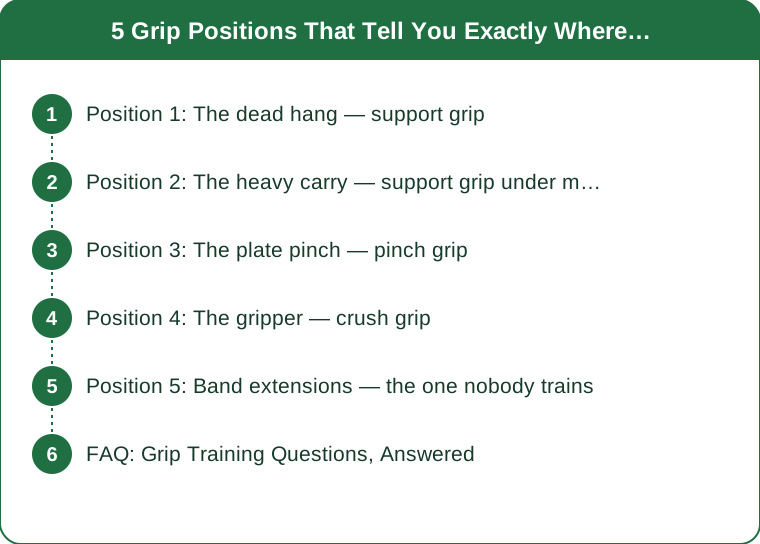
Position 2: The heavy carry — support grip under movement
What it tests: the same support grip as the hang, but with the load shifting, the shoulder working, and your whole trunk fighting to stay upright. It is a different quality in practice, and it usually fails sooner than a static hang would predict.
How to test it: farmer’s carry with something around half your bodyweight per hand, walking at a normal pace. Distance to grip failure is the number. Under 20 metres suggests the dynamic version specifically needs work.
Why it fails first: every step transmits a small oscillation up the arm, and the hand has to continuously re-grip against it. Add sweat, a smooth handle and a rotating implement, and the demand rises further. This is the version of grip that real life and most sports actually require.
How to train it: carries, unloaded on distance rather than time. Two or three sets of 30–50 metres, at a load you can hold without your form breaking. Increase load before distance. Mixing handle types — thick bar, dumbbell, kettlebell, trap bar — trains the adjustment rather than one specific hand shape.
The detail that matters most: how you hold it. Gripping deep in the palm with the handle sitting across the base of the fingers is stronger and more secure than holding it in the fingers, and it costs nothing to fix. Most people carry with the bar too low in the hand and lose thirty percent of their capacity to that alone.
Position 3: The plate pinch — pinch grip
What it tests: pinch grip — thumb opposing fingers, no wrapping around anything. It is the most neglected grip quality and the one with the largest gap between people who train it and people who do not.
How to test it: two 10kg plates, smooth sides out, pinched between thumb and fingers, held at your side. Ten seconds is respectable; if you cannot lift them at all, this is a significant gap.
Why it matters: the thumb is the limiting factor in a very large proportion of real-world grip tasks — anything held rather than hung from, anything wide, anything without a handle. It also contributes substantially to closed-hand grip strength, because thumb opposition is what stabilises the wrap.
How to train it: plate pinches for time, block pinches, and holding a heavy dumbbell by the head rather than the handle. Two or three sets of 15–30 seconds, and it responds fast because it starts from such a low base in most people.
Watch the thumb position. The pad of the thumb, not the tip, and the wrist neutral rather than flexed. Pinching with a bent thumb tip is how people irritate the thumb joint, and it is the most common reason people abandon pinch work after a fortnight.
Position 4: The gripper — crush grip
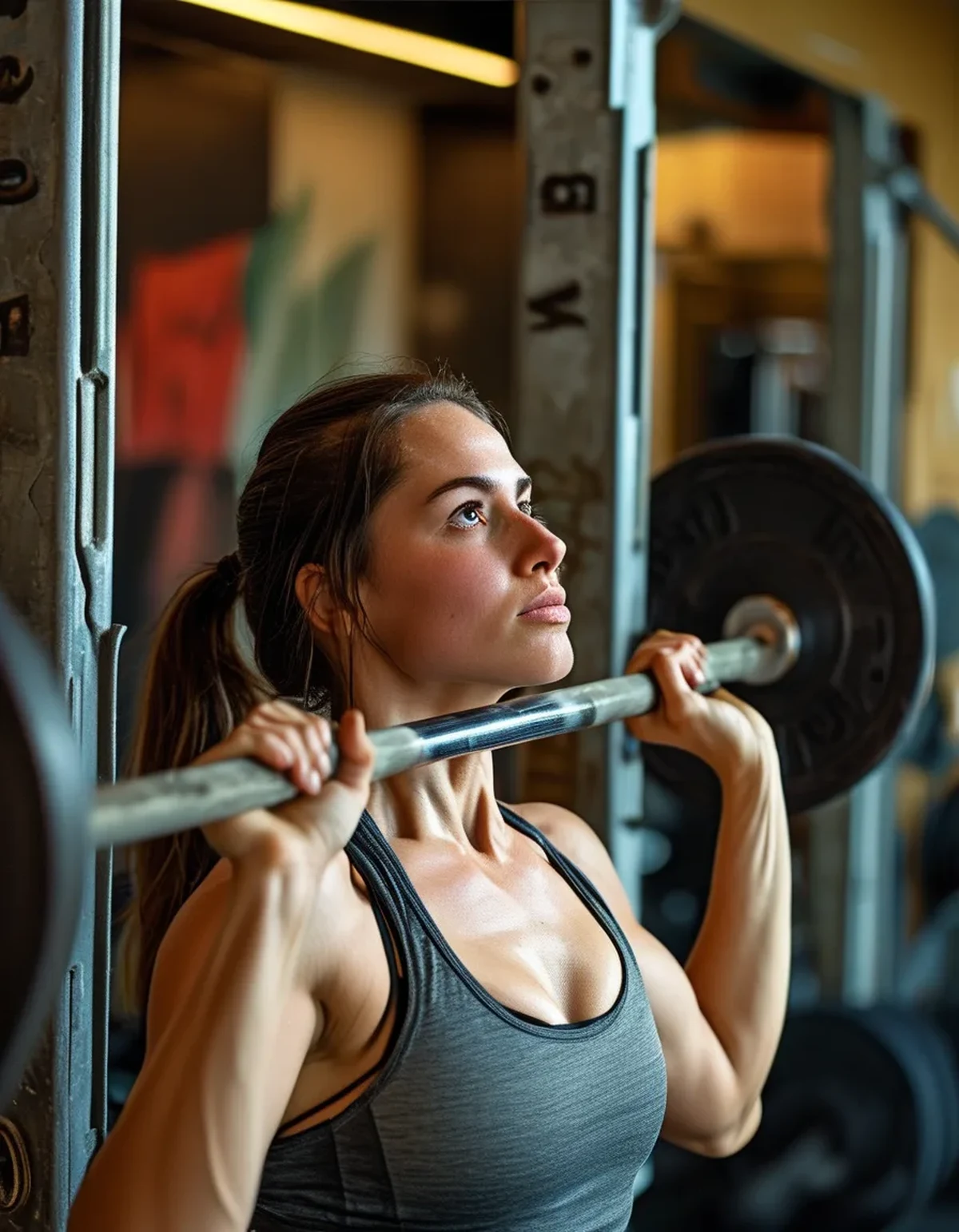
What it tests: crush grip, the closing action of the fingers against resistance. This is the one everyone thinks of as grip strength, and it is the least relevant to lifting performance.
How to test it: a calibrated gripper, or a dynamometer if your gym has one. Dynamometer readings are useful because they are comparable — but treat any single number as a rough guide rather than a verdict.
Why it matters less than you would think: crush grip is a dynamic closing action, and almost nothing in lifting requires you to close your hand against resistance. Deadlifts require you to hold a hand already closed. That is support grip, and the two correlate less than people assume.
Where it does matter: grappling, climbing on certain holds, and anything involving controlling another person or a moving object. If your sport involves gripping something that is actively trying to escape, crush is genuinely your quality.
How to train it: grippers, with actual progression rather than repping the same one forever. Sets of 5–8 controlled closes, or timed holds at the closed position, which usefully blends crush and support.
The mistake here is training only this. A large number of people with impressive gripper numbers still lose deadlifts, because they have trained the one grip quality that deadlifting does not use.
Position 5: Band extensions — the one nobody trains
What it tests: finger and wrist extension — the opposite action to everything else on this list. It is not a performance quality, it is a balance and health one, and it is why it belongs on the list.
How to test it: put a rubber band around all five fingertips and open the hand against it. If 20 slow repetitions is difficult, your extensors are dramatically weaker than your flexors, which is normal and worth correcting.
Why it matters: every other thing you do trains the flexors. Gripping, carrying, pulling, typing, holding a phone. Nothing trains the extensors, and the resulting imbalance is implicated in lateral elbow pain, forearm tightness and the general sense that your forearms never fully relax.
How to train it: rubber band extensions, 2–3 sets of 15–25, or a rice bucket with opening movements. It takes three minutes and it is the highest-value three minutes in this whole article for anyone whose elbows have started complaining.
Also worth adding: wrist extension and radial/ulnar deviation work with a light dumbbell or a lever. Wrist stability underpins every grip position above, and a wrist that collapses under load makes the hand weaker regardless of how strong the fingers are.
The pattern across all five positions: whichever one you found hardest to read about is probably the one you have been avoiding. That is usually the right place to start. This is general information rather than medical advice — persistent elbow or wrist pain is worth a proper assessment rather than more volume.
FAQ: Grip Training Questions, Answered
How often should I train grip?
Two or three short sessions a week is plenty, and it stacks well at the end of a normal training session. Grip recovers quickly but it also accumulates fatigue that will affect your pulling, so keep the volume modest and put it after the work that matters.
Do straps make my grip weaker?
Not directly, but they remove the stimulus. Use them for high-volume or heavy pulling where grip would limit the target muscle, and go strapless on your lighter sets so your hands still get worked. All-strap or never-strap are both worse than the mix.
Why do my forearms feel tight all the time?
Usually a flexor–extensor imbalance, sometimes compounded by desk work. Extension work and some soft-tissue attention to the forearm usually help within a couple of weeks. If it comes with numbness or pain that radiates, get it looked at properly.
How fast should I expect grip to improve?
Support grip responds quickly — many people add 50% to their dead hang time within a month of training it directly. Pinch improves fast from a low base. Crush is slower and more strength-like. All of it is trainable at any age.
TL;DR:
- Grip is at least four capacities: support, pinch, crush and extension, over a foundation of wrist stability.
- Test all five positions; the one that fails first is what to train, and it is rarely the gripper.
- Support grip — dead hangs and carries — is the one that limits most lifting, and it improves within weeks.
- Pinch is the most neglected, and extension is the three minutes that keeps your elbows quiet.
Train the position that failed, not the one you are already good at.
Keep Reading
This article is for general informational purposes only and is not medical advice. Always consult a qualified health professional for guidance specific to you.