5 Grip Positions That Reveal Where Your Strength Actually Fails
Quick Answer: Grip breaks down into crush, support, pinch, extension and wrist stability, and they train separately. Most people who say their grip is weak are specifically weak in support grip or pinch, and general forearm work does not fix a specific weakness. Test all five, then train the one that fails first.
Five positions, what each one tells you, and what to do about it.

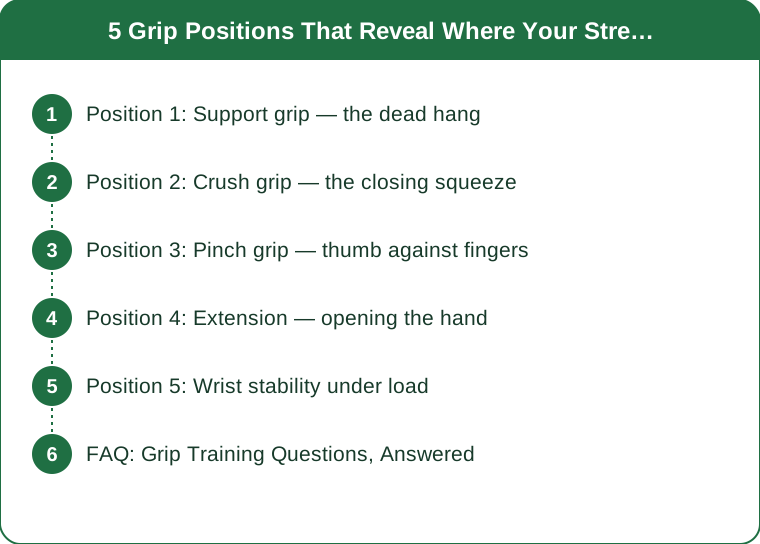
Position 1: Support grip — the dead hang
What it tests. Isometric holding endurance in the fingers, which is what fails on deadlifts, carries and pull-ups.
How to test it. Hang from a bar with a full grip, feet off the ground, and time it. Roughly 30 seconds is a reasonable baseline for most adults, and 60 seconds is solid.
What failure looks like. The fingers slowly open despite full effort. This is the most common grip failure by a wide margin, and it is the one people notice on their heaviest sets.
How to train it. Farmer’s carries and timed hangs. Three sets of 30 to 45 seconds, two or three times a week, produces noticeable change within a month. Add load rather than time once you pass 60 seconds comfortably.
Position 2: Crush grip — the closing squeeze
What it tests. The force you can generate closing the hand, which is what a handshake or a gripper measures.
How to test it. A hand dynamometer if you have access to one, or a spring gripper. Note that this is the grip most people assume is the important one, and it is often the least relevant to lifting.
What failure looks like. Difficulty generating force at all rather than gradually losing it — a different sensation from support grip failure.
How to train it. Grippers or heavy towel squeezes, three sets of 8 to 12 with a hard squeeze and a controlled release. Crush grip responds well but transfers less to barbell work than support grip does, which is worth knowing before spending much time on it.
Position 3: Pinch grip — thumb against fingers
What it tests. Thumb strength and the opposition between thumb and fingers, which is the most commonly neglected element of grip.
How to test it. Pinch two weight plates together, smooth sides out, and hold. Holding a pair of 5kg plates for 20 seconds is a fair starting benchmark.
What failure looks like. The plates rotate and slide out almost immediately. Many people with good support grip are dramatically weak here.
How to train it. Plate pinches and holding a thick book by the cover. Three sets to near-failure, twice a week. Improvements come fast because the starting point is usually so low.

Position 4: Extension — opening the hand
What it tests. The extensor muscles on the back of the forearm, which oppose everything else on this list and are almost never trained directly.
How to test it. Wrap a rubber band around the fingertips and open the hand against it. Thirty controlled repetitions should be manageable.
What failure looks like. The movement is small and shaky, and the forearm burns quickly.
How to train it. Rubber band finger extensions, two sets of 15 to 20, or opening the hand against rice in a bucket. This is the position most associated with elbow discomfort in people who grip heavily, because the imbalance between flexors and extensors builds over time.
Position 5: Wrist stability under load
What it tests. Whether the wrist holds a neutral position when the hand is loaded, which determines whether force transfers or leaks.
How to test it. Hold a light dumbbell at arm’s length and slowly rotate the wrist through its range. Watch for a point where control disappears.
What failure looks like. The wrist collapses backwards under load, which shows up in pressing, front racks and any handstand work.
How to train it. Wrist curls and reverse wrist curls through full range, plus loaded carries with the wrist deliberately neutral. Two sets of 12 to 15 each, twice a week.
This is general information, not medical advice. Persistent wrist or elbow pain is worth a professional assessment rather than more training volume.
FAQ: Grip Training Questions, Answered
Should I use straps?
For your heaviest pulling sets, yes — training the back should not be limited by grip. Do your lighter sets strapless so grip still gets worked. Using straps for everything is what creates the weakness in the first place.
How often can I train grip?
Forearms recover quickly and tolerate three sessions a week comfortably. The limit is usually elbow tissue rather than muscle, so add extension work if the elbows start complaining.
Does grip strength really predict health outcomes?
Grip strength correlates with overall health and mortality in large population studies, but it is a marker of general condition rather than a cause. Training grip specifically improves grip; it does not substitute for training everything else.
TL;DR:
- Grip is five separate qualities: support, crush, pinch, extension and wrist stability.
- Support grip fails first for most lifters — train it with hangs and carries.
- Pinch grip is the most neglected and improves fastest from a low base.
- Extension work is almost never done and is closely tied to elbow comfort.
- Use straps on your heaviest pulls and go strapless on lighter sets so grip still trains.
Test all five once. The one that embarrasses you is the one worth training.
Keep Reading
This article is for general informational purposes only and is not medical advice. Always consult a qualified health professional for guidance specific to you.