5 Grip Holds That Train Completely Different Things
Quick Answer: Grip splits into distinct capacities — crush, support, pinch, extension, and wrist stability — and training one does not build the others. Most people only train support grip (holding a bar) and then wonder why a jar lid still defeats them. Train each with a dedicated hold: dead hangs for support, a towel row for crush, plate pinches for pinch, band extensions for the openers, and loaded carries for wrist stability.
Your deadlift grip is fine and you still cannot open a jar. Your pull-ups are good and your hands cramp carrying grocery bags up two flights.
Grip is at least five separate things wearing one name. Here are five holds, one for each.

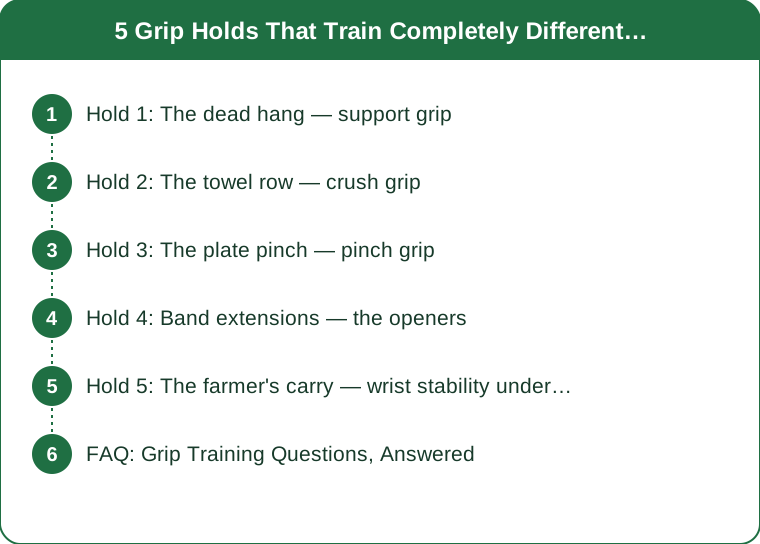
Hold 1: The dead hang — support grip
What it trains: your ability to hold on to something for time. This is the capacity that fails during deadlifts, pull-ups, and carrying anything heavy for distance.
How to do it: hang from a pull-up bar with straight arms, shoulders active rather than fully relaxed, feet off the ground. Start with 3 sets of 15 to 20 seconds and build toward 3 sets of 60.
Why this hold specifically: support grip is endurance under a sustained isometric load, and nothing trains an isometric like an isometric. A 60-second dead hang is a meaningful benchmark for most adults and takes a few months to reach from scratch.
The detail people miss: do not let the bar roll to your fingertips. Hook your fingers over and keep the bar in the crease where your fingers meet your palm — this is a stronger and safer position, and it also builds a callus pattern you can live with.
Progression: longer holds first, then added weight in a vest or belt, then a thicker bar. Thicker implements are the single best grip progression available and cost nothing if you wrap a towel around the bar.
Hold 2: The towel row — crush grip
What it trains: squeezing force. This is the jar-lid, handshake, hand-gripper capacity, and it is almost entirely untrained by normal gym work.
How to do it: drape a towel over a bar or attach it to a cable, grip one end in each hand, and row. 3 sets of 8 to 10 with a weight that makes your hands the limiting factor rather than your back.
Why this hold specifically: a towel forces a closing action rather than a hooking one. Your fingers have to actively crush the fabric for the entire set, which is what a bar never asks for.
Why crush grip matters beyond the gym: it is the capacity most associated with daily-life hand function, and it declines earliest with age. Grip strength is one of the more widely studied simple markers of general physical function, and crush is what most of those measurements test.
The variation worth adding: a towel-wrapped dumbbell carry, held for time. Same crush demand, no back involvement, so your hands genuinely become the limiting factor.
A hand gripper works too and is far more portable — just pick one you can close for 8 to 10 reps rather than one you can barely close once.
Hold 3: The plate pinch — pinch grip
What it trains: thumb-against-fingers force, which is a completely separate system from everything above and the weakest link for nearly everyone.
How to do it: hold two smooth 10lb plates together, flat sides out, pinched between your thumb and fingers. Hold for time — 3 sets of 20 to 30 seconds per hand.
Why this hold specifically: the thumb works in opposition to the fingers, and no bar exercise loads that opposition. Pinch strength is the most neglected grip quality in almost every training program.
Where it shows up in real life: carrying a laptop, holding a heavy book, gripping a wide lid, climbing. Rock climbers train this deliberately and almost nobody else does.
Progression: add a third plate, use heavier plates, or move to a thicker pinch. Smooth plates are much harder than plates with a lip — start with whatever you can hold for 15 seconds.
Do this at the end of a session, never before anything that needs grip. Pinch work fatigues the thumb quickly and it takes a while to come back.

Hold 4: Band extensions — the openers
What it trains: the muscles that open your hand, which oppose every other exercise on this list and are essentially never trained.
How to do it: put a rubber band around your fingertips and thumb and open your hand against it. 3 sets of 15 to 20, slow on the way back in.
Why this hold specifically: all grip training is closing. The extensor muscles on the back of the forearm get no work at all, and that imbalance is a documented contributor to elbow and forearm overuse pain in people who train grip hard.
This is the prevention exercise on the list. It builds very little visible strength and it protects the training you do elsewhere. Lifters with persistent forearm pump or lateral elbow discomfort should start here before adding more grip volume.
Equipment: a cheap office rubber band works, and dedicated finger extensor bands cost about $10 for a set. Rice bucket work does the same job if you have a bucket and ten minutes.
Frequency: this one can be done daily. It is low load and high frequency by design — treat it like mobility work rather than like strength work.
Hold 5: The farmer’s carry — wrist stability under load
What it trains: everything at once, plus the wrist and shoulder stability that grip work in isolation misses.
How to do it: pick up a heavy dumbbell or kettlebell in each hand and walk. 3 to 4 sets of 30 to 40 metres, or 30 to 45 seconds if space is limited.
Why this hold specifically: the load moves, which means your wrist has to stabilize continuously rather than holding one position. This is the closest thing to how grip is used in real life — a suitcase, grocery bags, a toddler.
It is also a core exercise. Heavy asymmetric or bilateral load forces the trunk to work hard to keep you upright. Farmer’s carries deliver more than their reputation suggests and they are the single most time-efficient item on this list.
Form points: shoulders down and back, ribs stacked over hips, walk normally rather than leaning. If your shoulders round forward, the weight is too heavy for the purpose.
Progression: heavier, longer, or thicker handles. Thick-handled carries are brutally effective and a towel wrapped around the handle achieves it for free.
Programming all five: dead hangs and carries twice a week after your main lifts, towel rows once a week, pinch holds once a week, band extensions daily. That is roughly 15 minutes of added work per week for a capacity most people never touch.
FAQ: Grip Training Questions, Answered
How often should I train grip?
Two dedicated sessions a week is plenty alongside normal lifting, with band extensions optionally daily. Grip recovers reasonably fast but the forearm is easy to overuse, and forearm pump that lingers is a signal to back off.
Should I use straps for deadlifts?
Use them for your heaviest work if grip is limiting your back training, and go without on lighter sets so grip still gets trained. Both, at different times, rather than one or the other.
Does grip strength really predict health outcomes?
Grip strength is widely used in research as a simple proxy for overall muscular function, and it correlates with a range of health measures. Correlation is not the same as causation — training grip alone does not deliver the benefits of training generally.
Why do my forearms pump up and stay that way?
Usually too much closing work with no extensor work to balance it. Add the band extensions and reduce grip volume for a week before doing anything else.
This is general information, not medical advice.
TL;DR: Five capacities, five holds, about fifteen minutes a week.
- Dead hang for support grip — build to 3 sets of 60 seconds.
- Towel row for crush grip — the jar-lid capacity that bar work never trains.
- Plate pinch for thumb opposition — the weakest link for nearly everyone.
- Band extensions for the openers — the prevention exercise that protects everything else.
- Farmer’s carry for wrist stability under a moving load — closest to real life, and a core exercise too.
- Thicker handles are the best free progression on every one of these. A towel around the bar does it.
Add dead hangs and carries to the end of two sessions this week. The other three take five minutes and can wait until those feel routine.
Keep Reading
This article is for general informational purposes only and is not medical advice. Always consult a qualified health professional for guidance specific to you.