5 Farmers Carry Mistakes That Are Quietly Wrecking Your Grip Gains
Quick Answer: The most common farmers carry mistake is letting the shoulders round forward and the grip loosen mid-carry as fatigue sets in — both quietly cut the exercise’s grip-strength benefit short. Fixing posture and grip consistency matters more than adding weight.
The farmers carry looks like the simplest exercise in the gym, which is exactly why small form errors go unnoticed the longest.

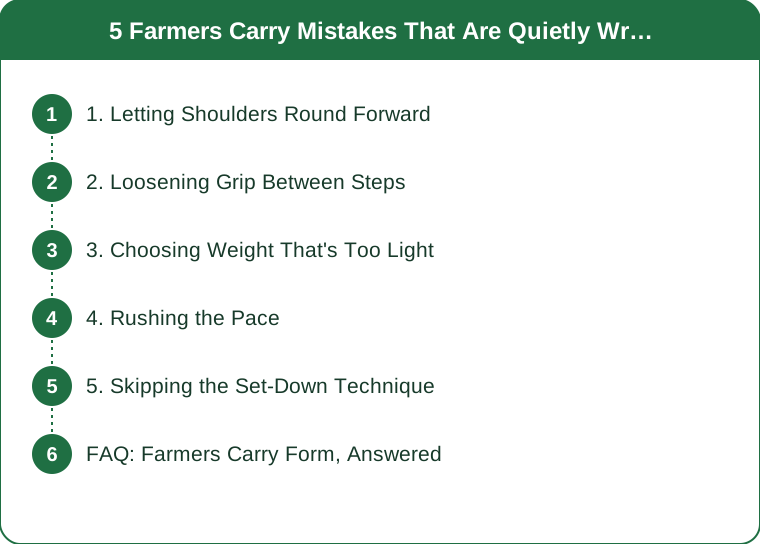
1. Letting Shoulders Round Forward
As grip fatigue sets in, shoulders tend to round and pull forward to compensate — this shifts load away from the intended full-body tension pattern and reduces how much the exercise actually challenges grip and posture together. Keep shoulders pulled back and down for the entire carry, not just the first few steps.
2. Loosening Grip Between Steps
Some lifters subtly relax and re-grip with each stride, especially as forearms fatigue. This defeats the sustained-tension purpose of the exercise — grip should stay maximally engaged from pickup to set-down, not pulse open and closed.
3. Choosing Weight That’s Too Light
Farmers carries are most effective at a weight where you genuinely struggle to hold on for the target distance or time — a weight you could carry easily for 5 minutes trains endurance more than raw grip strength. Aim for a weight that challenges grip within about 30-45 seconds.

4. Rushing the Pace
Walking too fast turns the exercise into a cardio challenge rather than a controlled grip and posture challenge. A controlled, deliberate pace keeps tension consistent and reduces the risk of the weights swinging, which adds unwanted momentum.
5. Skipping the Set-Down Technique
Dropping the weights at the end of a set, rather than setting them down with control, skips the eccentric portion of the grip challenge — which is often where the most strength-building tension happens. Set down deliberately, don’t drop.
FAQ: Farmers Carry Form, Answered
How far or how long should a farmers carry set be?
A common target is 30-45 seconds or roughly 40-60 feet, adjusted based on the weight — if you’re grip-failing well before that, the weight is likely appropriate; if you’re barely challenged, it’s too light.
Should I use a straps-free grip, or is using straps OK?
For grip-strength-specific training, skip straps entirely — that’s the whole point of the exercise. Save straps for pure load-carrying conditioning work.
How often should farmers carries appear in a training week?
1-2 times a week is typical, with at least 48 hours of recovery for the forearms between sessions.
TL;DR:
- Keep shoulders pulled back throughout, not just at the start of the carry
- Grip should stay maximally engaged the whole time — no loosening between strides
- Pick a weight that challenges grip within 30-45 seconds, not one you could hold all day
- Set weights down with control instead of dropping them, for the full eccentric benefit
Next time you program farmers carries, check these 5 points before adding more weight — form fixes usually unlock more grip gain than load increases do.
Keep Reading
This article is for general informational purposes only and is not medical advice. Always consult a qualified health professional for guidance specific to you.