The 8-Week Dead Hang Progression That Takes You From 10 Seconds to a Full Minute
Quick Answer: Start with 3-4 sets of the maximum comfortable hang time (even 10-15 seconds), add 5 seconds per week, and build toward a 60-second total hang time over 6-8 weeks using rest-pause sets rather than one continuous max effort.
A 10-second dead hang feels like nothing compared to a full minute. The gap closes faster than expected with the right week-by-week structure — here’s exactly how.

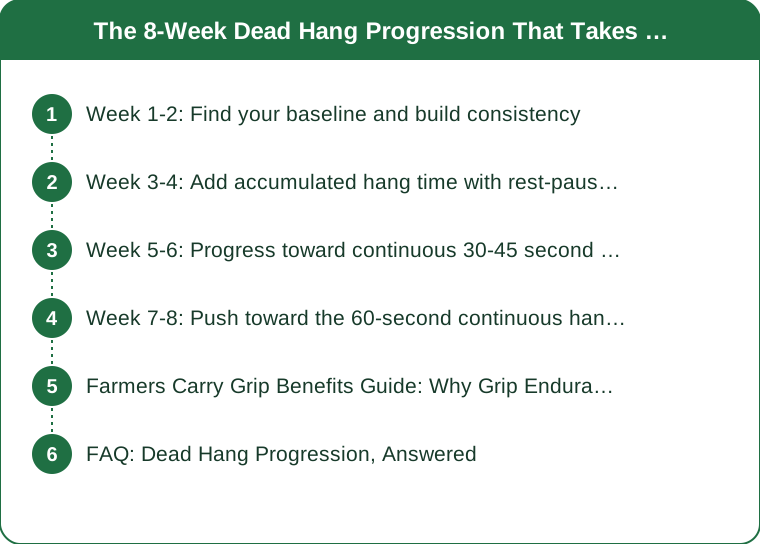
Week 1-2: Find your baseline and build consistency
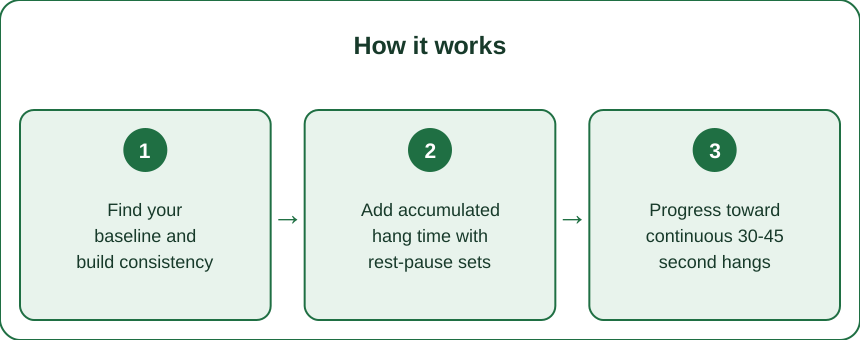
Test the maximum comfortable hang time — most beginners land somewhere between 10-25 seconds. Perform 3-4 sets of that duration, resting 60-90 seconds between sets, 2-3x per week. The goal isn’t pushing to failure yet, just establishing a consistent baseline the body can build from.
Week 3-4: Add accumulated hang time with rest-pause sets
Rather than one continuous max hang, break the target into shorter segments with brief rest — for example, three 15-second hangs with 10-second rests count toward a 45-second accumulated total. This rest-pause method builds grip endurance faster than repeatedly failing at one long continuous hang.
Week 5-6: Progress toward continuous 30-45 second hangs
By this point, most people can string together a continuous hang approaching 30-45 seconds. Reduce the rest-pause breaks and start testing longer unbroken hangs once a week to track real progress, while keeping the rest-pause method for the other training sessions.

Week 7-8: Push toward the 60-second continuous hang goal
The final phase focuses on one long weekly max-effort test hang alongside continued rest-pause volume work. A 60-second continuous dead hang is a commonly used grip endurance benchmark, and by week 8 most people following this progression get within reach of it or achieve it.
Farmers Carry Grip Benefits Guide: Why Grip Endurance Matters Beyond the Hang
Grip endurance built through dead hangs carries over directly to farmer’s carries, deadlifts, and pull-up volume, since grip fatigue is often the limiting factor in those exercises well before the target muscle group actually tires out. Building the hang independently removes the grip bottleneck from other training.
FAQ: Dead Hang Progression, Answered
Is it normal for grip to fatigue faster than expected in week 1?
Yes — grip endurance is a very specific adaptation, and even people who are strong elsewhere often start with a low baseline dead hang time.
Should wrist or forearm pain stop the progression?
Sharp or persistent pain (different from normal muscular fatigue) should pause the plan and warrants checking form and possibly consulting a professional.
Can dead hangs be done every day instead of 2-3x per week?
Most programs recommend 2-3x weekly with rest days between, since grip flexor tissue needs recovery time similar to other muscle groups.
TL;DR:
- Start with your comfortable max hang time, done for 3-4 sets, 2-3x weekly
- Use rest-pause sets (short hangs, brief rest) to accumulate more total hang time than one continuous attempt
- Progress from accumulated time toward one continuous hang, testing weekly
- Dead hang grip endurance carries over directly to farmer’s carries, deadlifts, and pull-ups
An 8-week progression turns a 10-second struggle into a genuine 60-second hang — and fixes the grip bottleneck in half your other lifts along the way.
Keep Reading
This article is for general informational purposes only and is not medical advice. Always consult a qualified health professional for guidance specific to you.