5 Signs Your Grip Is the Limiting Factor, Not Your Strength
Quick Answer: Grip is the limiting factor when the bar leaves your hands while the target muscle still has reps left. The five clearest signs are: the bar rolling toward your fingers, one hand failing before the other, straps adding a large jump in reps, forearm pump arriving before back or leg fatigue, and grip failing on the last set of a session but not the first. Each points at a different fix — technique, imbalance, capacity, endurance or fatigue management.
Most people either assume their grip is fine or assume it is the problem, and rarely check which.
Here are five specific things to look for, each with a photograph-clear description of what it looks like and what to do about it.

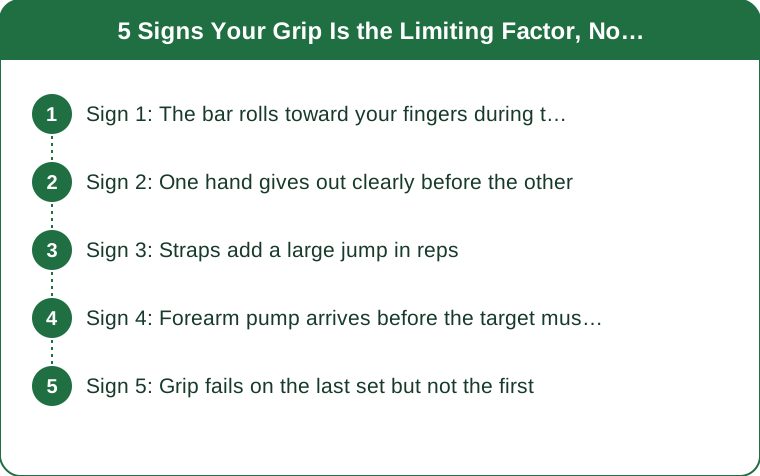
Sign 1: The bar rolls toward your fingers during the set
What it looks like: you set up with the bar across the base of your palm, and by rep six it has migrated down into your fingers. The last rep is being held by your fingertips, and you have to reset your grip between sets.
This is the most common and most misread sign. It looks like weak fingers, and it usually is not — it is a technique and skin friction issue combined with insufficient crush strength.
Why it happens: a bar in an open hand rotates under load, and every rep it walks a fraction further toward the fingers. Once it is in the fingers, the lever arm on each finger joint is longer, which makes it dramatically harder to hold. That is why the last two reps feel disproportionately bad rather than gradually worse.
What it tells you to train: crush grip and setup. Set the bar deliberately across the base of the fingers rather than deep in the palm — counterintuitively, a bar too deep in the palm rolls more, because the skin folds around it. Squeeze hard before you lift rather than after.
Direct work that helps: heavy holds at the end of a session. Load a barbell to a weight you can hold for 20 to 30 seconds and hold it. Two or three sets, twice a week. This trains exactly the failure you are experiencing.
And use chalk. A large share of bar roll is skin friction, not strength, and chalk is the single most effective intervention available. If your gym does not allow loose chalk, a liquid chalk is nearly as good and considerably tidier.
Sign 2: One hand gives out clearly before the other
What it looks like: on a deadlift or a farmer’s carry, the same side always fails first. You notice yourself regripping on one side, or the bar tilts as the weaker hand slips.
Why it happens: almost everyone has a dominant hand with meaningfully more grip strength, and the gap can be substantial. Bilateral exercises hide it until the weaker side becomes the limit for both. It can also come from a previous wrist or elbow injury, from nerve irritation, or simply from a lifetime of one-handed tasks.
Why it matters more than it seems: on a barbell, the weaker hand caps the load for the whole lift, which means your stronger side is undertrained on every set. Over months that widens the gap rather than closing it.
What it tells you to train: unilateral grip work, weighted toward the weaker side. Single-arm farmer’s carries and single-arm dead hangs are the two most direct tools. Do the weaker side first, match the stronger side to the weaker side’s performance, and add an extra set on the weaker side once a week.
A mixed grip hides this and also creates its own asymmetry, since the supinated hand works differently from the pronated one. If you use a mixed grip, alternate which hand is which set to set rather than always the same way round.
Worth ruling out: if one hand has been progressively weakening rather than simply being weaker, and particularly if it comes with numbness, tingling or a change in sensation, that is worth a proper medical assessment rather than a training fix. This is general information, not medical advice.

Sign 3: Straps add a large jump in reps
What it looks like: you do a set of rows or deadlifts at a given weight and get eight reps. Same weight with straps and you get thirteen, with the back muscles finally reaching genuine fatigue.
Why it matters: this is the cleanest possible test of whether grip is limiting, and it gives you a number. A gap of one or two reps is normal — grip contributes some fatigue to every pulling exercise. A gap of five or more means you have been training your grip, not your back, on every set you thought was a back set.
Run the test properly: same weight, same day, strapped set after a full rest from the unstrapped set. Once every few months is plenty. Write the numbers down.
What it tells you to train: grip capacity, and separately from your pulling work. If the gap is large, straps are not cheating on your heavy back sets — they are the correct tool for training your back, and dedicated grip work is where you close the gap.
The productive structure: use straps on your heaviest pulling sets so the target muscle is actually loaded, then do specific grip work at the end of the session where fatigue does not compromise anything else. Trying to train both simultaneously with one exercise means neither gets a full stimulus.
A word against strap avoidance as a principle. Refusing straps entirely because grip should be trained means capping your back development at whatever your hands can hold. Both things can be trained; they just should not always be trained at the same moment.
Sign 4: Forearm pump arrives before the target muscle fatigues
What it looks like: midway through a set of pull-ups or rows, your forearms are burning and swollen and your back feels comparatively fresh. You stop because your arms feel like they will not hold, not because your back is done.
Why it happens: this is endurance rather than maximal strength. The forearm flexors are working isometrically for the whole set while the back works concentrically and eccentrically in phases. Sustained isometric contraction restricts blood flow, metabolites accumulate, and you get the characteristic pump and burn well before the prime mover is finished.
The distinction that matters: if your grip fails on a single maximal attempt, that is maximal strength. If it fails during a long set or a long session, that is endurance. They need different training.
What it tells you to train: grip endurance specifically — long-duration, lower-intensity holds. Dead hangs for time, farmer’s carries for distance, and higher-rep holds. Aim for durations of 45 to 90 seconds rather than heavy 10-second efforts.
Reduce unnecessary gripping in the meantime. A death grip on every handle costs endurance you need later. Hooking the fingers over a pull-up bar rather than squeezing it, and keeping a relaxed hold on cable handles, both preserve capacity.
And check your bar. A thick bar dramatically increases grip demand — deliberately, and it is excellent training. It is also a hidden variable if the bar at your gym is thicker than the one you used to use, and it explains a sudden apparent loss of grip endurance that has nothing to do with you.
Sign 5: Grip fails on the last set but not the first
What it looks like: the first two working sets feel fine. By set four the bar is slipping on rep three, at the same weight you handled comfortably twenty minutes earlier.
Why it happens: grip fatigue accumulates across a session and recovers more slowly than people expect. The forearm flexors are involved in almost everything — warm-ups, accessory work, carrying dumbbells to the bench — so by the time you reach your heaviest set, they have been working for an hour.
What it tells you: the problem is session structure rather than strength. Your grip is strong enough; you spent it before you needed it.
What to change: put the exercise that most depends on grip early in the session, immediately after the warm-up. Deadlifts before rows, not after. Heavy carries at the start of a session, not as a finisher, if carries are a priority lift.
Cut incidental gripping. Use a hook or a strap on warm-up sets. Do not carry dumbbells further than necessary. Set the bar down between reps on a heavy set rather than holding it at the top.
Increase rest between grip-heavy sets. Grip recovers on a slightly slower timescale than large muscles, so a rest interval that suits your back may not suit your hands. Adding thirty to sixty seconds before the heaviest sets is often the whole fix.
And look at the week, not just the session. Grip work every day with no recovery produces exactly this pattern of good-early, bad-late performance, and the fix is a rest day for the hands rather than more training. This is especially worth checking now, as autumn brings training indoors and volume tends to rise — grip is usually the first thing to show accumulated fatigue when weekly volume climbs.
If forearm pain persists beyond normal training soreness, particularly near the elbow, stop adding grip volume and get it assessed. Persistent tendon pain is not something to train through.
TL;DR:
- Bar rolling into the fingers = crush strength and setup. Chalk plus heavy holds.
- One hand failing first = imbalance. Single-arm carries and hangs, weaker side first.
- Straps adding 5+ reps = grip has been capping your back work. Use straps on heavy sets, train grip separately.
- Forearm pump before back fatigue = endurance, not max strength. Long hangs and carries, 45-90 seconds.
- Failing only on the last set = session structure. Move grip-heavy lifts earlier and rest longer.
Run the strapped-versus-unstrapped rep test once. The number tells you which of these five you actually have.
Keep Reading
This article is for general informational purposes only and is not medical advice. Always consult a qualified health professional for guidance specific to you.