5 Grip Training Setups You Can Build From Gear You Already Own
Quick Answer: Five setups cover the full range of grip demands with equipment most people already have: a towel wrapped around any handle for thick-bar crush grip, a single weight plate pinched between fingers and thumb for pinch grip, a loaded bag or two heavy objects for support grip carries, a bar or beam for dead hangs, and a towel over a bar for the hardest version of all of them. Each trains a distinct capacity, and rotating through them beats hammering one.
Grip is not one thing, which is why one tool never covers it.

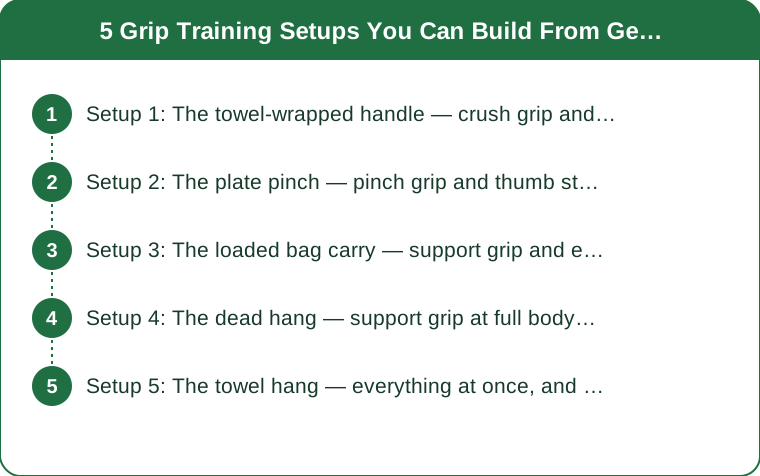
Setup 1: The towel-wrapped handle — crush grip and thick bar
What you need: any hand towel and any handle — a dumbbell, a kettlebell, a barbell, even a heavy bag handle.
How to build it: wrap the towel around the handle two or three times until the effective diameter is roughly double what it was. Grip over the towel. That is the whole setup.
What it trains: thick-bar grip, where your fingers cannot wrap fully around the handle. This dramatically increases the demand on the finger flexors and forearm, because a hand that cannot close fully generates far less force. It is why thick handles feel disproportionately harder than the weight suggests.
How to program it: use it for rows and carries at 50 to 60 percent of the weight you would normally use. Do not expect to match your usual loads — the point is that grip fails first, which is exactly the training stimulus.
Sets and reps: 3 sets of 6 to 8 reps for rows, or 3 carries of 20 to 30 seconds. Two sessions a week.
The detail people miss: wrap thickness is your progression variable. Add one more wrap when the current thickness gets manageable, and you have a progressive thick-bar setup for the price of a towel.
Setup 2: The plate pinch — pinch grip and thumb strength
What you need: one or two weight plates, ideally smooth-sided.
How to build it: hold a plate by its rim, smooth side out, pinched between the pad of your thumb and the pads of your four fingers. No hooking, no resting on the palm. For a harder version, pinch two plates together smooth-sides out.
What it trains: pinch grip, which is thumb-dominant and almost entirely neglected by normal training. Every pulling exercise trains crush and support grip; almost nothing trains the thumb.
Why it matters: thumb strength is the limiting factor in a wide range of practical tasks and in several sports, and it is the grip capacity that declines most obviously when untrained.
How to program it: hold for time. 3 to 4 sets of 20 to 30 seconds per hand, or carry the pinched plate for distance. Start light — a 5kg plate is genuinely challenging for most people on the first attempt.
Progression: heavier plate, two plates, then a plate with a smaller lip. Add a set before you add weight.

Setup 3: The loaded bag carry — support grip and endurance
What you need: a duffel bag, a backpack, two shopping bags, or anything with a handle that can be loaded.
How to build it: load a bag with books, water bottles, or plates until it is genuinely heavy but liftable in one hand. For a bilateral version, use two evenly loaded bags.
What it trains: support grip — the ability to hold a load for time without the hand opening. This is the most functionally relevant grip capacity and the one that translates most directly to carrying groceries, luggage and children.
Why a bag beats a dumbbell: the load shifts and swings, which means the grip is constantly correcting rather than holding a static position. That instability is a feature.
How to program it: carry for distance or for time. 4 to 5 carries of 30 to 45 seconds, resting fully between. Walk normally, shoulders down, ribs stacked over hips.
Progression: more weight, then longer duration, then a thinner handle. A thin handle on a heavy bag is brutal and free.
Setup 4: The dead hang — support grip at full body weight
What you need: a pull-up bar, a sturdy beam, a playground bar, or a doorway bar.
How to build it: hang from a bar with straight arms, shoulders slightly engaged rather than fully passive, feet off the ground. Full body weight through both hands.
What it trains: maximal support grip endurance, plus shoulder and lat positioning. It is the single most efficient grip exercise because it loads the hand with your entire body weight without any equipment beyond something to hang from.
How to program it: accumulate total hang time rather than chasing one long hang. 4 to 6 sets, each stopped 5 seconds before failure, aiming for 90 to 120 seconds of total accumulated time. Two or three sessions a week.
Benchmarks worth knowing: 30 seconds is a reasonable starting target for most people, 60 seconds is solid, 90-plus is strong.
Progression path: two-hand hang, then a towel over the bar, then a one-arm assisted hang with the other hand on your wrist. Add weight only after you can comfortably hold 60 seconds unweighted.
Setup 5: The towel hang — everything at once, and the hardest
What you need: one or two towels and the same bar.
How to build it: drape a towel over the bar and grip both ends, or use two towels for a shoulder-width grip. Hang.
What it trains: all of it simultaneously — crush grip, thumb involvement, support endurance, and the added demand of gripping a compressible, shifting surface that gives no help at all. There is no bar to rest against, so the hand does 100 percent of the work.
Expect a large drop-off. Someone who can hang 60 seconds from a bar might manage 15 to 20 seconds on towels. That is normal and is exactly why it is worth doing.
How to program it: 3 to 4 sets, stopping before form degrades into a slide. Once or twice a week — this is the highest-fatigue option on the list and it loads the forearms and elbows hard.
A caution: towel work is demanding on the medial elbow. If you have any history of elbow tendon irritation, build in slowly and treat any elbow pain as a signal to back off rather than push through.
How to combine all five: pick two per session, rotate through the list over a week, and put grip work at the end of a training day rather than before anything that needs your hands.
TL;DR:
- Towel-wrapped handles give you progressive thick-bar training for the cost of a towel.
- Plate pinches are the only setup on this list that trains the thumb, which nothing else does.
- Loaded bag carries train support grip with instability that a dumbbell cannot replicate.
- Dead hangs are the most efficient grip exercise available — accumulate 90 to 120 seconds per session.
- Towel hangs combine everything and are the hardest; once or twice a week is plenty.
Grip is several separate capacities, and rotating two setups per session covers all of them without buying a single piece of grip equipment.
Keep Reading
This article is for general informational purposes only and is not medical advice. Always consult a qualified health professional for guidance specific to you.