5 Grip Training Mistakes That Show Up as Elbow Pain
Quick Answer: Most grip-related elbow pain comes from five habits: training crushing grip almost exclusively, adding volume faster than tendons adapt, never training the extensors that balance the flexors, gripping maximally on every set including light ones, and skipping rest days because grip work feels minor. Tendon tissue adapts far more slowly than muscle, so the volume that feels manageable this week is often what produces symptoms in three weeks. Persistent elbow pain needs professional assessment rather than more stretching.
Grip work feels like a small accessory thing you can add freely to anything. Tendons disagree, on a delay of a few weeks.
Here are the five habits that produce that delayed bill.

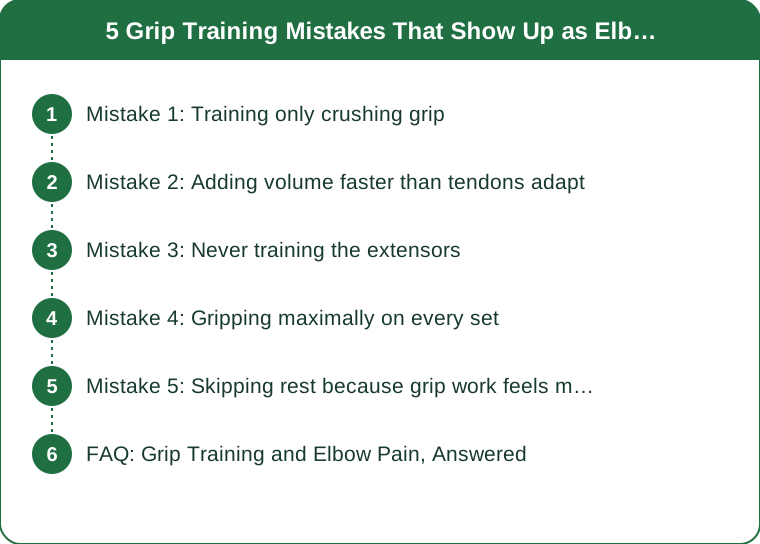
Mistake 1: Training only crushing grip
Crushing grip - the hand closing against resistance, as with a gripper - is one of several grip types, and it is the one everybody trains. Support grip, pinch grip, and wrist and finger extension all get neglected.
The finger flexors that produce crushing force originate at the medial epicondyle, the bony point on the inside of the elbow. Loading them repeatedly and exclusively concentrates stress at exactly that attachment.
Training a variety of grip types distributes load across different tissues and produces better results anyway, because each type has limited carryover to the others.
A balanced week includes at least one heavy support hold - a farmers carry or a dead hang - alongside any crushing work.
Pinch grip work adds a different demand entirely, using the thumb against the fingers rather than the fingers against the palm, and it is the most commonly missing element.
If you only fix one thing on this list, this is a reasonable candidate, because variety alone reduces the repetitive concentration that causes the problem.
Mistake 2: Adding volume faster than tendons adapt
Muscle adapts in days to weeks; tendon adapts over weeks to months. This mismatch is the single most important fact in this article.
It means the grip volume that feels comfortable now can be more than your tendons are ready for, and the feedback arrives late enough that you have already repeated it several times.
Increase grip volume by around ten percent a week at most, and treat that as a ceiling rather than a target.
Count all of it. Deadlifts, rows, carries, pull-ups, and rock climbing are all grip work, and grip training added on top of a heavy pulling week is often the actual overload.
A sudden change of activity is the classic trigger - starting climbing, taking up a racket sport, a week of DIY, or moving house. The tendons had no notice.
Progress hold time before you progress load. Extending a carry from 30 to 45 seconds is a gentler progression than adding five kilos, and it builds the same capacity.
Mistake 3: Never training the extensors
Almost all grip training is flexion - closing the hand. The extensors that open the hand and lift the wrist get essentially nothing, and the resulting imbalance is a well-recognised contributor to elbow symptoms.
Extensor work takes about ninety seconds. A rubber band around the fingers, opened against resistance for two sets of 20, is enough to start.
Rice bucket work or a simple wrist extension with a very light weight covers it equally well. This is genuinely low-effort insurance.
Do it after grip work, not before, so you are not fatiguing the antagonists ahead of the main work.
Keep the load very light. Extensors are small muscles and the goal is balance and blood flow rather than strength gains.
Two or three times a week is plenty, and it is one of the highest ratios of benefit to effort available in a training programme.

Mistake 4: Gripping maximally on every set
Squeezing the bar as hard as possible on every warm-up and light set adds substantial cumulative load for no training benefit.
Reserve maximal grip effort for the sets that actually need it. A light row does not require a death grip, and treating it as if it does triples your weekly grip volume without you noticing.
Straps are a legitimate tool, not cheating. Using straps on high-volume pulling work while training grip separately and deliberately gives you more control over total load, which is exactly what tendons need.
Hook grip and mixed grip change the stress distribution and can be useful for varying the load, though mixed grip has its own asymmetry to manage.
Watch your grip habits outside the gym too. Carrying shopping in one hand, a heavy bag on one shoulder, and long days of manual work all add up in the same account.
The general principle is that grip is a shared resource across everything you do, and budgeting it deliberately is more effective than training it harder.
Mistake 5: Skipping rest because grip work feels minor
Grip work feels small, so people do it daily. Daily gripper work is one of the more common routes to medial elbow pain, precisely because it never feels like enough to warrant a rest day.
Tendons need recovery time between loading sessions, and 48 hours between heavy grip sessions is a reasonable default.
Two to three dedicated grip sessions a week is enough for almost everyone, particularly when incidental grip work from pulling exercises is counted.
Early warning signs are worth respecting: a dull ache on the inside of the elbow after training, morning stiffness in the forearm, or discomfort when turning a doorknob or wringing a cloth.
Continuing to train through those signs is what turns a two-week problem into a three-month one, and it is the most common regret in this area.
Persistent elbow pain, pain that wakes you, numbness, tingling, or weakness needs professional assessment rather than more stretching or a different gripper. Tendon problems respond well to properly progressed loading, and that progression is worth getting from someone who can assess you. This is general information, not medical advice.
FAQ: Grip Training and Elbow Pain, Answered
Why does grip training hurt my elbow and not my hand?
The finger flexors that close your hand originate at the medial epicondyle on the inside of the elbow. Repeated loading concentrates stress at that attachment, so the symptom appears well away from where the effort felt.
How fast can I add grip volume?
Around ten percent a week at most, counting all grip work - deadlifts, rows, carries, pull-ups, climbing, and manual work all belong in the total. Tendons adapt over weeks to months, not days.
Do I really need to train the extensors?
Yes, and it takes about ninety seconds. A rubber band around the fingers opened against resistance, two sets of 20, two or three times a week, is enough to offset an otherwise entirely flexion-based routine.
Is using straps cheating?
No. Straps let you control total grip load by removing it from high-volume pulling work, so you can train grip deliberately rather than accumulating it accidentally.
How often should I train grip?
Two to three dedicated sessions a week with at least 48 hours between heavy ones. Daily gripper work is a common route to medial elbow pain.
When should I see someone about it?
If pain persists beyond a couple of weeks, wakes you at night, or comes with numbness, tingling, or weakness. This is general information, not medical advice.
TL;DR:
- Grip flexors attach at the inside of the elbow, which is why grip mistakes present as elbow pain.
- Train support and pinch grip alongside crushing grip - variety distributes the load that repetition concentrates.
- Add no more than about ten percent volume a week, and count deadlifts, rows, carries, climbing, and manual work in the total.
- Spend ninety seconds on extensor work two or three times a week; it is the best effort-to-benefit ratio available.
- Stop gripping maximally on light sets, use straps to control total load, and leave 48 hours between heavy grip sessions.
- Persistent pain, night pain, numbness, or weakness needs assessment. This is general information, not medical advice.
Tendons send the invoice about three weeks after the training that earned it.
Keep Reading
This article is for general informational purposes only and is not medical advice. Always consult a qualified health professional for guidance specific to you.