5 Grip Tests You Can Do at Home and What Each One Tells You
Quick Answer: Grip has distinct qualities - crush, support, pinch, and extension - and they train and fail separately. A dead hang tests support grip endurance, a plate pinch tests thumb-opposed pinch strength, a towel hang tests grip under an unstable surface, a farmer carry tests loaded support under fatigue, and a band extension test measures the opening strength that almost nobody trains. Test all five, and the weakest one is your programme.
Most people describe grip as one thing that is either strong or not. Then they can hang for ninety seconds but cannot hold a plate pinch for ten, and it becomes obvious that whatever grip is, it is not a single number.

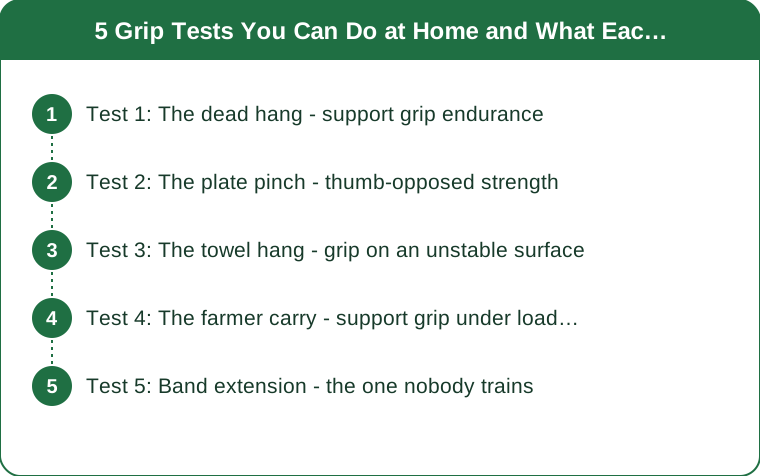
Test 1: The dead hang - support grip endurance
What it is. Hang from a pull-up bar with both hands, arms straight, feet off the ground, and time how long you can hold before your hands open.
What it measures. Support grip - the ability to hold a closed hand position under load over time. This is the quality that fails during pull-ups, rows, and deadlifts, and it is the most commonly trained and most commonly assumed to represent grip generally.
How to do it properly. Use a full grip with the thumb wrapped, hang from a bar you can reach without jumping if possible, and stop when your hands open rather than when it becomes uncomfortable. Do it fresh, not at the end of a session.
Rough interpretation. Thirty seconds is a reasonable starting benchmark for an adult with some training history; a minute is solid; well beyond that is strong. These are practical markers rather than validated norms, and body weight matters - a heavier person is holding more load for the same duration.
What a poor result means. Your grip fails before your back does in pulling work, which caps everything you can train there. This is the most limiting single grip weakness for most gym training.
What to train. Dead hangs themselves, three to five sets held near failure, two or three times a week. Straps for heavy pulling work so the back can be trained, with unstrapped work programmed separately - using straps for everything is what creates this gap in the first place.
Test 2: The plate pinch - thumb-opposed strength
What it is. Pinch a smooth weight plate between thumb and fingers, lift it off the floor, and hold. Two plates pressed together, smooth sides out, is the standard version.
What it measures. Pinch grip - the thumb working in opposition to the fingers. This is a distinct capacity from support grip, and it relies heavily on the thumb, which most training neglects entirely.
How to do it properly. Chalk if you have it, plate clean and dry, hold for time or simply lift for a personal best weight. Test each hand separately.
Rough interpretation. Most people are considerably worse at this than they expect relative to their hanging ability. If you can hang for a minute and cannot pinch-hold a 10 kg plate for fifteen seconds, that gap is the finding.
Why it matters beyond the gym. Pinch strength is what carries a laptop, holds a heavy lid, opens a jar, and grips a climbing hold. It transfers to daily tasks more directly than hang time does.
What a poor result means. Underdeveloped thumb strength, which is extremely common because almost no standard exercise loads the thumb in opposition.
What to train. Plate pinches for time, three sets of twenty to thirty seconds per hand. Progress by adding plate weight or reducing rest. Pinch carries - walking while holding the pinch - add a useful loaded element.

Test 3: The towel hang - grip on an unstable surface
What it is. Drape a towel over a pull-up bar, grip one end in each hand, and hang.
What it measures. Grip on a thick, deformable, unstable surface. The towel compresses and shifts, so the hand cannot settle into a fixed position, and the forearm has to work continuously to maintain it.
How to do it properly. One towel, ends of similar length, full grip. Compare against your bar dead hang time.
Rough interpretation. Expect a substantial drop from your bar hang - often to a third or less. That drop is normal and its size is the information.
What a large gap means. Your grip is well adapted to a fixed, optimally sized handle and much less adapted to anything else. Real-world grip demands - carrying awkward objects, holding a rope, climbing - are much closer to the towel condition than to a bar.
Why it matters. Thick and irregular grip work is one of the most efficient ways to develop forearm strength, because it forces near-maximal effort from the finger flexors at loads well below your bar-hang maximum.
What to train. Towel hangs, thick-bar or fat-grip work, and rope pulls. Two or three sets, twice a week, is enough to shift this quickly - it responds faster than most grip qualities.
Test 4: The farmer carry - support grip under load and fatigue
What it is. Pick up a heavy weight in each hand, stand tall, and walk until your grip gives out. Measure distance or time.
What it measures. Support grip under real load with whole-body demands - breathing, bracing, walking - competing for attention. This is grip as it actually gets used.
How to do it properly. Weights you can hold for at least twenty to thirty seconds, neutral posture, controlled walk. Use dumbbells, kettlebells, or shopping bags with something heavy in them.
Rough interpretation. Being able to carry roughly half your body weight in each hand for a minute is a strong general benchmark. Being able to carry a moderate load a substantial distance is more relevant for most people than a maximal test.
Why it differs from the dead hang. In a hang, the load is fixed and your body is still. In a carry, the load swings, your trunk works, and you are breathing hard - all of which degrade grip faster than the load alone would.
What a poor result means. Grip endurance under real conditions is limited, which is what actually constrains carrying luggage, moving furniture, and holding a child on one hip.
What to train. Carries themselves, and they are among the highest-value exercises available. Two to four sets of thirty to sixty seconds, once or twice a week. Vary the implement - handles of different thickness change the demand substantially.
Test 5: Band extension - the one nobody trains
What it is. Put a rubber band or purpose-made extensor band around all five fingertips and open your hand against the resistance. Count repetitions to fatigue.
What it measures. Finger extension strength - the muscles that open the hand, which are the antagonists to everything else on this list.
How to do it properly. A thick elastic band or a dedicated extensor trainer. Full opening, controlled return, count until you cannot complete a full range repetition.
Rough interpretation. Almost everyone is weak here, and if you have never trained it, expect to fatigue within twenty to thirty repetitions with modest resistance.
Why it matters more than it sounds. Every gripping activity - training, typing, tools, phones - trains the flexors. Nothing trains the extensors, which produces a large and growing imbalance around the elbow and wrist. That imbalance is associated with elbow and forearm discomfort, and extensor work is a standard part of managing it.
What a poor result means. A normal but worth-correcting imbalance, particularly if you do a lot of gripping work or have any elbow niggles.
What to train. Band extensions, two to three sets of fifteen to twenty-five repetitions, three times a week. It takes ninety seconds, needs almost no equipment, and is among the highest-return-per-minute things in this article.
Quick FAQ
How often should I retest? Every six to eight weeks. Grip adapts steadily but not weekly.
Should I train grip every day? No - the forearm flexors recover like any other muscle. Two or three focused sessions a week is plenty alongside normal training.
Is grip strength really linked to health? Large studies have found grip strength correlates with a range of health outcomes, though correlation there reflects overall muscular condition rather than grip itself being protective. Train it as part of general strength, not as a magic marker.
Persistent hand, wrist, or elbow pain is worth having assessed rather than trained through. This is general information, not medical advice.
TL;DR:
- Grip is at least four separate qualities and they fail independently - test all of them.
- Dead hang for support endurance, plate pinch for thumb strength, towel hang for unstable surfaces.
- Farmer carries test grip the way life actually uses it, under load and fatigue at once.
- Band extensions train the openers, which nothing else in your life does, and take ninety seconds.
- Your weakest test is your programme. Retest every six to eight weeks, not weekly.
Hanging for a minute and failing a ten-second plate pinch is not a contradiction. It is two different muscles doing two different jobs, and only one of them has been trained.
Keep Reading
This article is for general informational purposes only and is not medical advice. Always consult a qualified health professional for guidance specific to you.