5 Grip Strength Benchmarks Worth Testing at the End of Summer
Quick Answer: Grip strength is measurable at home with almost no equipment, and it is one of the better proxies available for overall strength and long-term function. The five benchmarks worth knowing are the dead hang, the farmers carry, the plate pinch, the timed towel hang and the crush test - and each one measures a different grip type, which is why people strong at one can be weak at another. Testing all five takes about fifteen minutes and tells you exactly where to train.
End of summer is a natural point to take stock before an autumn training block, and grip is the quality most people have never actually measured.
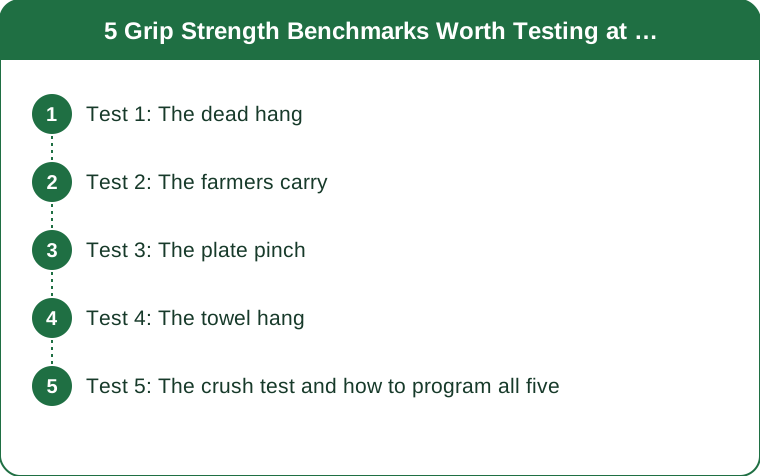
Here are the five tests, in the order worth doing them, with what each one is telling you.

Test 1: The dead hang
What it measures: support grip endurance - your ability to hold your own bodyweight.
Hang from a pull-up bar with an overhand grip, hands about shoulder width, arms straight, and hold until you cannot. Do not kip, do not adjust, do not use straps.
Useful reference points for women: under 15 seconds suggests grip is a limiting factor in most pulling work. 30 seconds is a reasonable working standard. 60 seconds is genuinely strong. 90 seconds and above is exceptional.
This is the most informative single test because support grip is what limits deadlifts, rows, pull-ups and carries. If your deadlift stalls at a weight you can move for one rep but not five, this is almost certainly the reason.
What it does not tell you is anything about crush or pinch strength, which are genuinely separate qualities. Someone can hang for two minutes and be unable to hold a pair of plates together.
How to move it: hang at the end of every session, twice a week, for three sets. Add ten seconds every two weeks. It responds fast - most people add 50 percent in six weeks - because the limiting factor early on is largely skin tolerance and neural, not muscular.
Test 2: The farmers carry
What it measures: support grip under load, plus trunk stability and posture under load.
Pick up a dumbbell or kettlebell in each hand and walk. The standard reference is carrying half your bodyweight per hand for 60 seconds, though that is a genuinely advanced target.
A practical progression to work toward: a quarter of your bodyweight per hand for 60 seconds is a solid baseline. A third is strong. Half is very strong.
What makes this test more useful than a dead hang is that it is loaded and dynamic. Grip fails differently under movement, and the carry exposes the interaction between grip, shoulder position and trunk control that a static hang does not.
Watch what fails first. If your hands open, it is grip. If your shoulders round forward and your neck strains, it is upper back. If you start leaning, it is trunk. The carry tells you which of the three is your actual limitation, which is information no other single test gives you.
How to move it: carries twice a week, one heavy and short - 20 to 30 seconds - and one lighter and long, 60 to 90 seconds. The two develop different things and both matter.

Test 3: The plate pinch
What it measures: pinch grip - thumb against fingers, with no wrapping.
Stand two smooth-sided plates together, smooth sides out, and pinch them between your thumb and fingers. Lift and hold.
Reference points: holding two 10-pound plates for 20 seconds is a reasonable standard for most women. Two 15s is strong. Two 25s is exceptional.
Pinch is the grip type most people have never trained and it is the one with the biggest gap between people who train it and people who do not. It is almost entirely thumb strength, and the thumb is neglected in essentially every standard training program.
Why it matters beyond the number: pinch strength is what carries awkward objects - a laptop bag, a box, a stack of plates - and it is the grip type most associated with real-world capability rather than gym capability.
How to move it: plate pinches for three sets of 20 to 30 seconds, twice a week. Start with two 5s if two 10s is not close. This is the test that improves most dramatically with direct training, often doubling in two months, because almost nobody has any training history in it.
Test 4: The towel hang
What it measures: grip under a compromised, thick, deforming surface - the hardest version of support grip.
Drape a towel over a pull-up bar, grip one end in each hand, and hang.
Reference points: 15 seconds is a solid result. 30 seconds is strong. Anything above 45 is genuinely impressive, and most people who dead hang for a minute will be surprised to fail at 20 seconds on a towel.
The towel removes the thing that makes a bar easy: a fixed diameter you can close your hand around. A towel deforms, so the grip has to be maintained by continuous force rather than by a locked position.
This is the closest gym test to the demands of climbing, obstacle racing, grappling and any real-world carrying of a bag or a deformable object.
It is also the most honest test of whether your grip strength is real or positional. People whose dead hang relies on hooking the fingers over the bar and hanging on skeletal structure find the towel exposes it immediately.
How to move it: towel hangs and towel rows, twice a week. Start with two towels - one per hand, which is thicker and easier to hold than one folded - and progress to a single thin towel. Expect it to feel disproportionately hard at first.
Test 5: The crush test and how to program all five
What it measures: crushing force - the closing strength of the whole hand.
This one needs a hand dynamometer or a graded gripper. A dynamometer gives you a number in kilograms and is the version used in research - and it is the grip measure most consistently associated with broader health and functional outcomes in large studies, which is why it is worth knowing even if you never train it directly.
Reference points for adult women vary considerably with age, but roughly 25 to 30kg is average in the middle decades, with meaningfully higher numbers in trained populations. The trend over time matters far more than any single reading.
Programming all five. You do not need a dedicated grip day. Two additions to what you already do covers all five qualities:
End of every upper body session: three dead hangs to near failure, and three plate pinches. Five minutes total.
Once a week: heavy carries, plus one set of towel hangs. Ten minutes.
Stop using straps for everything. Straps have a place on your heaviest pulling sets, but using them on all work sets removes the single largest grip stimulus in your program. Use them on the top sets only and let the back-off sets train your hands.
Retest all five in eight weeks. Grip responds faster than almost any other quality, and seeing three of five improve substantially is the normal result.
TL;DR:
- Five distinct grip types - support, loaded support, pinch, deforming-surface and crush - and being strong at one predicts little about the others.
- Dead hang 30 seconds is a reasonable working standard; 60 is strong.
- Farmers carry a quarter bodyweight per hand for 60 seconds as a baseline, and watch what fails first.
- Pinch is the most neglected and the fastest to improve - almost nobody has trained it.
- The towel hang exposes positional grip that a bar lets you fake.
- Stop using straps on back-off sets - that alone changes most people’s grip within two months.
Fifteen minutes of testing tells you which of five things to train, instead of guessing.
Keep Reading
This article is for general informational purposes only and is not medical advice. Always consult a qualified health professional for guidance specific to you.