5 Grip Holds That Fix Different Weak Points
Quick Answer: Grip has distinct qualities that fail separately: crush (closing the hand), support (holding on over time), pinch (thumb against fingers), hook (fingers as passive hooks), and wrist and extensor balance. Most people train only support grip and wonder why the other four remain weak. These five holds each target one, and the one that fails first in your lifting is the one to train.
If your deadlift is limited by your hands, or a bar slips out of a hang, or a plate is impossible to carry by the rim, those are three different problems.

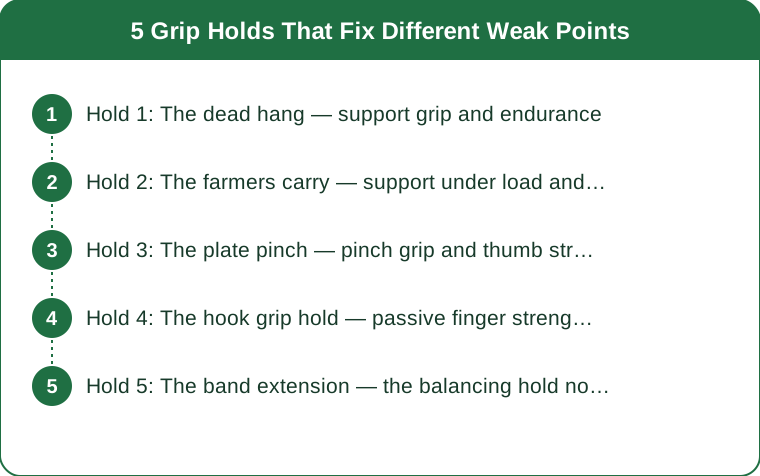
Hold 1: The dead hang — support grip and endurance
What it trains: support grip, the ability to hold on to something for time. This is the quality that limits pull-ups, heavy carries, and any hang.
How to do it: hang from a pull-up bar with a full overhand grip, thumb wrapped, shoulders active rather than fully passive. Feet off the floor, body still.
What to aim for: work up to 60 seconds unbroken. Most people start between 15 and 30. Three to four sets, two or three times a week, added to the end of a session.
Why it works: support grip is primarily an endurance quality, and endurance responds to time under tension. Holding for time is a more direct stimulus than repeated closing.
Common mistake: hanging completely relaxed with the shoulders at the ears. Some active engagement through the shoulder protects the joint and makes the hold a genuine training stimulus rather than a passive stretch.
Progression: add time first, then add load with a weight belt or a held dumbbell between the feet. Do not add load until you can hold 60 seconds clean.
Good for: anyone whose deadlift, row, or pull-up sets end because their hands opened rather than because the target muscle failed.
Hold 2: The farmers carry — support under load and everything else
What it trains: support grip under heavy load, plus core stability, shoulder stability, and postural endurance. It is the most transferable single grip exercise there is.
How to do it: pick up a heavy dumbbell or kettlebell in each hand, stand tall with the ribs down, and walk. Shoulders back, arms straight, controlled steps.
What to aim for: 30 to 40 meters per set, or 30 to 45 seconds, for 3 to 4 sets. Load should be heavy enough that the last few steps are genuinely hard.
Why it works: the load is heavy, the duration is long, and the demand is on holding rather than closing - which maps directly onto real lifting and real life.
Common mistake: going too light and walking too far. A carry that you could continue indefinitely is a walk, not a grip exercise. If you can go 100 meters comfortably, add weight.
Progression: increase load rather than distance once you can complete 40 meters. Thick-handled implements or grip attachments raise the difficulty substantially without more weight.
Good for: general grip strength, anyone who wants one exercise rather than five, and anyone whose grip fails in the last set of a workout rather than the first.
Hold 3: The plate pinch — pinch grip and thumb strength
What it trains: pinch grip - the thumb working against the fingers. This is the most neglected quality and often the weakest.
How to do it: hold two smooth weight plates together, flat sides out, pinched between thumb and fingers at the rim. Stand tall and hold.
What to aim for: 20 to 30 seconds per hand, 3 sets. Start with two 5 kg plates and progress from there. Ten kilos pinched per hand is a solid intermediate target.
Why it works: the thumb is not trained by any bar-based exercise, because a bar grip lets the fingers do nearly all the work. Pinch grip is the only common movement that loads the thumb directly.
Common mistake: letting the plates rest on the fingers rather than pinching. The plates should be held by opposing pressure, not by a shelf. If you can hold it without your thumb, the position is wrong.
Progression: heavier plates, or the same weight held longer. A hex dumbbell held by one end is a good alternative if you do not have smooth plates.
Good for: anyone who struggles to carry things by the rim, climbers, and anyone whose grip strength has plateaued despite plenty of hanging and carrying.
Hold 4: The hook grip hold — passive finger strength and pain tolerance
What it trains: hook grip - thumb trapped under the fingers, so the hand holds the bar passively rather than by muscular closing. Used by essentially every competitive lifter for a reason.
How to do it: wrap the thumb around the bar first, then close the fingers over the thumb. Deadlift the bar to lockout and hold.
What to aim for: 10 to 20 seconds at a load close to your working deadlift weight, 2 to 3 sets. Start considerably lighter than you expect while the position is unfamiliar.
Why it works: it removes muscular closing from the equation entirely, so the bar is held by structure rather than by effort. It is what allows heavy pulls without straps and without a mixed grip.
Common mistake: giving up after two sessions. Hook grip is genuinely uncomfortable at first and the discomfort reduces substantially over two to four weeks as the thumb adapts. Nearly everyone who abandons it does so in the first fortnight.
Progression: more load, more time, and eventually using it for working sets. Tape on the thumb helps significantly in the adaptation phase.
Good for: anyone whose deadlift is limited by grip, anyone using a mixed grip who wants to stop, and anyone who wants to train without straps.
Hold 5: The band extension — the balancing hold nobody does
What it trains: finger and wrist extensors - the muscles on the back of the forearm that open the hand. These are the antagonists to everything above, and almost nobody trains them.
How to do it: place a rubber band or a dedicated extensor band around the fingertips and thumb, then open the hand against resistance. Slow on the way out, controlled on the way back.
What to aim for: 15 to 20 reps, 2 to 3 sets, most days. The load is low and the volume is high - this is not a heavy exercise.
Why it works: every grip exercise trains flexion. Training only one direction creates an imbalance that is associated with elbow and forearm discomfort, and the extensors are involved in wrist stability during heavy gripping.
Common mistake: skipping it because it feels trivial. It does feel trivial, and it is the exercise most likely to keep your elbows comfortable through a phase of heavy grip training.
Progression: thicker bands, more reps, or holding the open position for a count at the end of each rep.
Good for: anyone with elbow discomfort from lifting or climbing, anyone who types all day, and anyone doing a lot of the other four holds.
How do I know which one I need?
Notice how your grip fails. Hands open slowly during a set means support grip. Cannot hold anything without a handle means pinch. Bar rolls out of the fingers on heavy pulls means hook grip or crush. Aching outer elbow means extensors.
How often should I train grip?
Two to three sessions a week for the loaded holds, added at the end of a workout. Extensor work can be daily because the load is low.
Will grip work interfere with my main lifts?
Train it after your main work, not before. Heavy grip work at the start of a session will compromise everything that follows.
TL;DR:
- Grip is not one quality - support, crush, pinch, hook, and extension fail separately and train separately.
- Dead hangs build support endurance; farmers carries build support under load and transfer best.
- Plate pinches are the most neglected - the thumb gets no work from any bar exercise.
- Hook grip takes 2 to 4 weeks to stop being uncomfortable, and band extensions are what keep your elbows happy through all of it.
The useful diagnostic step is simply paying attention to how your grip gives out next time it does. Fingers slowly opening, thumb failing, bar rolling, and elbow aching are four different signals pointing at four different exercises on this list - and training the right one changes things within a few weeks, while training the wrong one changes nothing at all.
Keep Reading
This article is for general informational purposes only and is not medical advice. Always consult a qualified health professional for guidance specific to you.