5 Grip Exercises You Can Do While the Kettle Boils
Quick Answer: Grip is unusual among strength qualities: it responds extremely well to frequent short exposures rather than to occasional hard sessions. Three minutes, four or five days a week, produces measurable change in six to eight weeks. These five need a towel, a jar, a bag of rice, a book, and a doorframe - all of which you already own. Do two or three of them while the kettle boils, and treat the whole thing as a habit rather than a workout.
Each one below trains a genuinely different aspect of grip, so rotating through them covers crush, pinch, support, and extension - which is the full picture rather than just squeezing harder.

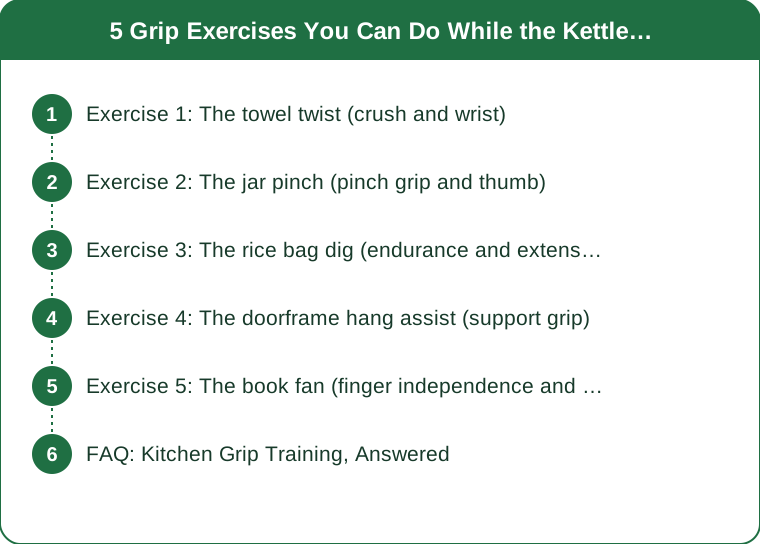
Exercise 1: The towel twist (crush and wrist)
The best all-round option and the one to do if you only do one.
Take a hand towel and roll it lengthways into a rope. Hold it with both hands, arms in front of you at chest height, and wring it as hard as you can in opposite directions as though you are squeezing water out of it. Hold the twist for 10 seconds, then reverse the direction and repeat.
Three rounds each direction is a complete set and takes about ninety seconds.
What it trains: crush grip in both hands simultaneously, plus wrist supination and pronation - the rotational strength that most grip work ignores entirely. It is also one of the few grip exercises that directly loads the wrist in rotation, which is where a lot of climbing, racket sport, and lifting weakness actually sits.
Progression: wet the towel. A damp towel is harder to hold and considerably harder to twist, and it is a genuine step up rather than a gimmick.
Why it works in a kitchen: you have a towel, it takes no setup, and there is no equipment to store. The barrier to doing it is essentially zero, which is the whole point of frequency-based training.
Exercise 2: The jar pinch (pinch grip and thumb)
The most neglected grip quality, and the one that carries over most obviously to real life.
Take a jar or a hardback book and hold it by pinching between thumb and fingers - fingers on one flat face, thumb on the other, no wrapping around. Hold at your side for 20-30 seconds, then swap hands.
Two to three holds per hand.
What it trains: pinch strength, which depends almost entirely on the thumb. This is the grip quality that fails first in most people and the one that almost never gets trained, because barbells and dumbbells are gripped with a wrap.
Why it matters: pinch strength is what you use to carry a laptop, hold a plate, open a jar, or pick up anything flat and heavy. It is also strongly correlated with overall hand function and it declines earlier than crush grip.
Progression: heavier books, or two books together to widen the pinch. Width is a bigger progression than weight - a wider pinch is dramatically harder.
Form note: keep the wrist straight and the shoulder relaxed. If you find yourself shrugging, the object is too heavy and the grip is no longer the limiting factor.
Exercise 3: The rice bag dig (endurance and extension)
The one that trains the muscles nobody trains, and the one that helps most with elbow pain.
Open a bag of rice or dried beans. Push your hand in up to the wrist, open your fingers wide against the resistance of the rice, then close them into a fist. Repeat for 30-45 seconds, then swap hands.
What it trains: both directions. Closing works the flexors like any grip work, but opening against resistance works the extensors on the back of the forearm - which are almost never trained and are usually far weaker than the flexors.
Why extensor work matters: the imbalance between strong flexors and weak extensors is implicated in tennis elbow and general forearm overuse pain, which is extremely common in anyone who lifts, climbs, or types all day. This is the most useful single exercise here for anyone with elbow niggles. If pain is persistent or sharp, see a professional rather than training through it - this is general information, not medical advice.
No rice? Use a rubber band. Loop a thick elastic band around all five fingertips and open the hand against it, 20 reps per hand. It is the same movement and it fits in a pocket.
Progression: deeper rice, or a thicker band. Time under tension matters more than resistance here.

Exercise 4: The doorframe hang assist (support grip)
Support grip - simply holding on for time - is the quality most people mean when they say their grip failed.
If you have a pull-up bar, hang from it. Feet on the ground taking some weight if needed, and hold for 20-30 seconds. Three holds.
If you do not, use the top of a doorframe - fingertips only, feet on the floor, leaning back to take some weight through the hands. Ten to twenty seconds is plenty, and it is genuinely hard.
A safety note before you try it: test the frame. Not every doorframe will take load, and modern hollow ones may not. Lean progressively rather than committing your weight, and stop immediately if anything flexes or creaks.
What it trains: support grip and finger flexor endurance, plus a useful shoulder and lat stretch that offsets a day at a desk.
Why it is worth including: support grip is what fails on deadlifts, carries, and pull-ups. It is trainable and it responds fast - most people add meaningful hang time within three weeks of daily practice.
Progression: less foot assistance, then longer holds, then one hand at a time with the other supporting lightly. Full unassisted hangs are the goal, and hitting 60 seconds is a genuinely good marker.
Exercise 5: The book fan (finger independence and extension)
The smallest and least glamorous one, and the one that carries over to anything requiring dexterity.
Hold a paperback flat in one hand. With the other hand, fan the pages apart and hold them open using only the fingers of the holding hand - spreading them, holding, releasing.
Alternatively, and more simply: place your hand flat on the table and lift one finger at a time, keeping the others down, for two sets through all five fingers on each hand.
What it trains: finger independence and the intrinsic muscles of the hand, which are the small muscles between the bones rather than the big forearm muscles. These are essentially untrained by conventional grip work and they matter for anything requiring control rather than force.
Who benefits most: musicians, climbers, and anyone who types all day. It is also the most useful one for hand health generally - the intrinsics weaken with age and disuse, and that weakening shows up as clumsiness before it shows up as weakness.
Progression: a rubber band around the fingers for the lifting version, or holding each lift for three seconds.
Do this one last, as a cool-down. It is precision work and it is better done on a hand that is warm rather than fresh.
FAQ: Kitchen Grip Training, Answered
How often should I do this?
Four or five days a week, three minutes at a time. Grip tolerates and rewards high frequency far better than most muscle groups. Doing all five every day is fine; doing two or three is more sustainable.
When will I notice anything?
Six to eight weeks for measurable change, but most people notice something practical - a jar opening more easily, a bag carrying further - within three or four.
Will this interfere with my gym training?
At this volume, no. If your forearms are still sore the next day, you did too much - reduce the holds rather than the frequency.
Is this enough on its own?
For general hand strength and health, yes. For serious strength carryover you still want heavy carries and deadlifts, but this fills the gaps those miss, especially pinch and extension.
Does grip strength really matter beyond the gym?
It is one of the better-studied simple markers of general physical function, which is why it gets measured in health research. Worth training on its own merits, not just for lifting.
What if I have arthritis or existing hand pain?
These are gentle, but check with a professional before starting anything new, and stop with anything that produces joint pain rather than muscle fatigue. This is general information, not medical advice.
TL;DR:
- Grip responds to frequency over intensity - three minutes, four or five days a week beats one hard session.
- Towel twist for crush and wrist rotation. Jar pinch for the thumb, which fails first and is never trained.
- Rice bag dig trains the extensors, which is the one that helps most with elbow pain.
- Doorframe or bar hang for support grip - the thing that actually fails on deadlifts and pull-ups.
- Finger lifts for the intrinsic muscles, which weaken with age and show up as clumsiness first.
- Measurable change in six to eight weeks; practical change sooner.
The reason this works is that grip is the one quality where the equipment barrier is the only real obstacle. Remove the barrier and the training happens, roughly ninety seconds at a time, while you wait for water to boil.
Keep Reading
This article is for general informational purposes only and is not medical advice. Always consult a qualified health professional for guidance specific to you.