5 Everyday Objects That Train Grip Better Than a Gripper
Quick Answer: A spring gripper trains crushing strength in one fixed hand position. Real-world grip needs four qualities - crush, support, pinch, and wrist stability - and the last three are what usually fail first. A towel, a bucket of water, a stack of books, a rolled magazine, and a wide jar cover all four, cost nothing, and can be trained in five-minute sessions at home.
Start with the towel hang. It exposes the weakest link faster than anything else on the list.

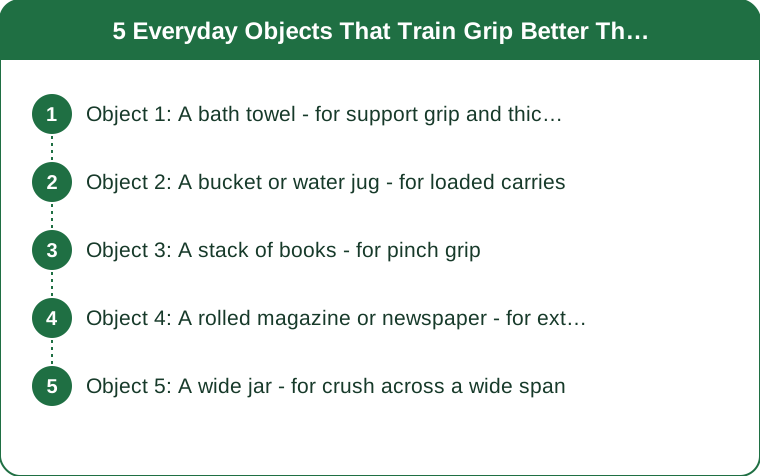
Object 1: A bath towel - for support grip and thickness
The towel is the most useful grip tool in an ordinary house, and it trains the quality that fails most often.
What it trains: support grip on a thick, unstable surface. Support grip is your ability to hold a load for time - the thing that gives out on the last set of deadlifts, on the walk home with shopping bags, on a hang. It is a different quality from crushing, which is what a gripper trains, and it is the one that limits people in real situations.
Thickness is the key variable. A thick implement is dramatically harder to hold because your fingers cannot wrap far enough to oppose the thumb effectively, so the load falls more on finger flexor endurance. A rolled bath towel is thick, and unlike a barbell it is also soft and compressible, so it deforms under load and constantly shifts - which recruits stabilizing muscles a rigid bar does not.
How to use it:
- Towel hang. Loop a towel over a pull-up bar or a sturdy door frame bar, grab one end in each hand, and hang. Start with three sets of as long as you can hold, resting fully between. Most people last a shockingly short time on the first attempt, which is the point.
- Towel row. Loop the towel around something solid at waist height, lean back, and row yourself in. Grip and back work at once.
- Towel wring. Soak a towel, then wring it out as hard as you can in both directions. Trains rotational grip and wrist strength, and it is genuinely difficult.
Start with the hang. Whatever you thought your grip was, the towel hang will give you a more honest number, and it improves quickly.
Object 2: A bucket or water jug - for loaded carries
Carrying something heavy for distance is the most functional grip exercise there is, and a bucket makes it available without a gym.
What it trains: support grip under load, plus everything that holds you upright while you carry. The farmer’s carry is a staple of strength training for good reason - it loads grip, forearms, shoulders, core, and postural muscles simultaneously, in a pattern that matches actual life.
A bucket of water is a particularly good implement because water moves. The load sloshes, shifting the center of mass constantly, which forces continuous grip and trunk adjustment. A rigid weight is easier to hold than a moving one of the same mass.
How to use it:
- Basic carry. Fill two buckets or jugs, one per hand, and walk. Aim for time rather than distance - 30 to 45 seconds per set is a reasonable target, three or four sets. Stand tall, shoulders back and down, and do not let the load pull you into a shrug or a lean.
- Suitcase carry. One side only, which forces your trunk to resist the sideways pull. Considerably harder than it sounds and better for core than most dedicated core exercises.
- Static hold. No walking, just hold at your sides until you cannot. Simplest way to build support grip endurance.
Loading it: a standard bucket holds a substantial amount of water and water is heavy, so most people can reach a genuinely challenging load with a household bucket. Adjust by how full you fill it, which makes progression easy - add an inch of water each week.
One safety note: hold the handle, keep the load close, and if it starts to slip, set it down deliberately rather than trying to save it.

Object 3: A stack of books - for pinch grip
Pinch grip is the most neglected grip quality and the one that transfers most to everyday tasks. A stack of books trains it perfectly.
What it trains: pinch strength - thumb opposing fingers with no wrapping. Nearly every conventional grip exercise lets the fingers wrap around something so the thumb does relatively little. Pinch removes that, and the thumb becomes the limiting factor. Since thumb strength is what fails when carrying a laptop, a stack of plates, or a sheet of plywood, it is worth training directly.
It is also, for most people, the weakest link by a wide margin. Someone who can hang from a bar for a minute may struggle to pinch-hold two hardbacks for fifteen seconds.
How to use it:
- Book pinch hold. Take two or three hardback books, stack them, and pinch the stack between thumb and fingers with your arm at your side. Hold for time. Three sets to near-failure per hand.
- Pinch carry. Same grip, but walk with it. Adds an element of movement and instability.
- Pinch and pass. Hold the stack in one hand, pass it to the other without setting it down. Trains the transition, which is where most real-world pinch failures happen.
Progression is easy - add a book. The smooth covers of hardbacks are an advantage rather than a problem, because a slick surface means the pinch has to be genuine rather than assisted by texture.
A warning worth heeding: pinch work loads the thumb joint substantially, and it is easy to overdo. Start with less than you think, build slowly, and stop if you get pain at the base of the thumb rather than muscle fatigue in the forearm.
Object 4: A rolled magazine or newspaper - for extension
Every other exercise on this list trains closing. This one trains opening, and skipping it is why forearms get sore and stay sore.
What it trains: finger extensors - the muscles on the back of the forearm that open the hand. These are dramatically weaker than the flexors in most people, because almost nothing in daily life trains them. Typing, carrying, gripping, holding a phone - all flexion.
That imbalance is worth taking seriously. Chronic forearm tightness, the persistent pump that will not go away, and several common elbow complaints are associated with heavily flexor-dominant loading with no extensor work. Adding extension is the single most useful thing you can do for forearm comfort if you train grip regularly.
How to use it:
- Magazine tear. Hold a magazine or a thick newspaper section by one edge with your fingertips and scrunch it into a ball using only that hand, then flatten it against a table using the back of the hand and fingers. The flattening motion is the extension work.
- Rubber band extensions. Not a magazine, but the same category and better for progression. Put a thick rubber band around all five fingertips and open your hand against it, slowly, for 15 to 20 repetitions. Multiple bands to progress.
- Table press. Place your fingertips on a table and press down, lifting the palm - a simple extensor contraction with no equipment.
Do this after grip work, not before, and do it consistently rather than heavily. Two or three sets of 15 to 20 easy repetitions a few times a week is enough to matter. This is maintenance work, not a strength lift, and the payoff is fewer forearm problems rather than a bigger number.
Object 5: A wide jar - for crush across a wide span
The one place a gripper is genuinely useful is crushing, and a wide jar trains the same quality across a span the gripper cannot reach.
What it trains: crush strength at a wide hand opening, plus rotational grip. A spring gripper has a fixed, fairly narrow span, and strength is highly position-specific - being strong at one hand opening does not mean being strong at another. Real objects come in every size, and the wide positions are usually the weakest.
A large jar or a wide-mouthed container puts the hand near the limit of its span, where the flexors have poor leverage. It is genuinely hard and it addresses a gap most grip training leaves open.
How to use it:
- Jar hold. Grip a large jar around the body - not the neck - with one hand and hold it out in front of you. Add water or dry goods to load it. Hold for time.
- Jar rotation. Grip and twist against resistance, which is the movement pattern of actually opening a stuck lid and involves wrist and forearm rotation as well as crush.
- Wide-span static squeeze. Simply squeeze an empty rigid jar as hard as you can for 10 seconds, five sets. No equipment cost, trains maximum crush at wide span.
Progression is by size before weight - a wider jar at the same load is harder than a narrower one heavier.
Putting it together: a reasonable weekly structure is towel hangs and carries twice a week for support, pinch and jar work once or twice for crush and pinch, and extensor work after every grip session. Ten to fifteen minutes total per session, and most people see measurable change within six to eight weeks. If any of it causes joint pain rather than muscular fatigue, back off - grip work loads small structures and progresses best slowly. This is general information, not medical advice.
TL;DR:
- A spring gripper trains crush at one fixed span; support, pinch, and extension are what usually fail first.
- Towel hangs train support grip on a thick unstable surface and expose your weakest link immediately.
- Bucket carries train loaded grip plus posture, and water sloshing makes it harder than a rigid weight.
- Book pinches train the thumb, which is most people’s weakest link by a wide margin - progress slowly, thumb joints load fast.
- Extensor work with a magazine or rubber band is the one thing that prevents the chronic forearm tightness heavy grip training causes.
Start with a towel hang tonight and time it. That number is your honest baseline. This is general information, not medical advice.
Keep Reading
This article is for general informational purposes only and is not medical advice. Always consult a qualified health professional for guidance specific to you.